
Restaurants · Pre Opening Playbook
The 90 Day Restaurant Launch: How to Use a 3D Window Display to Build Pre Opening Hype
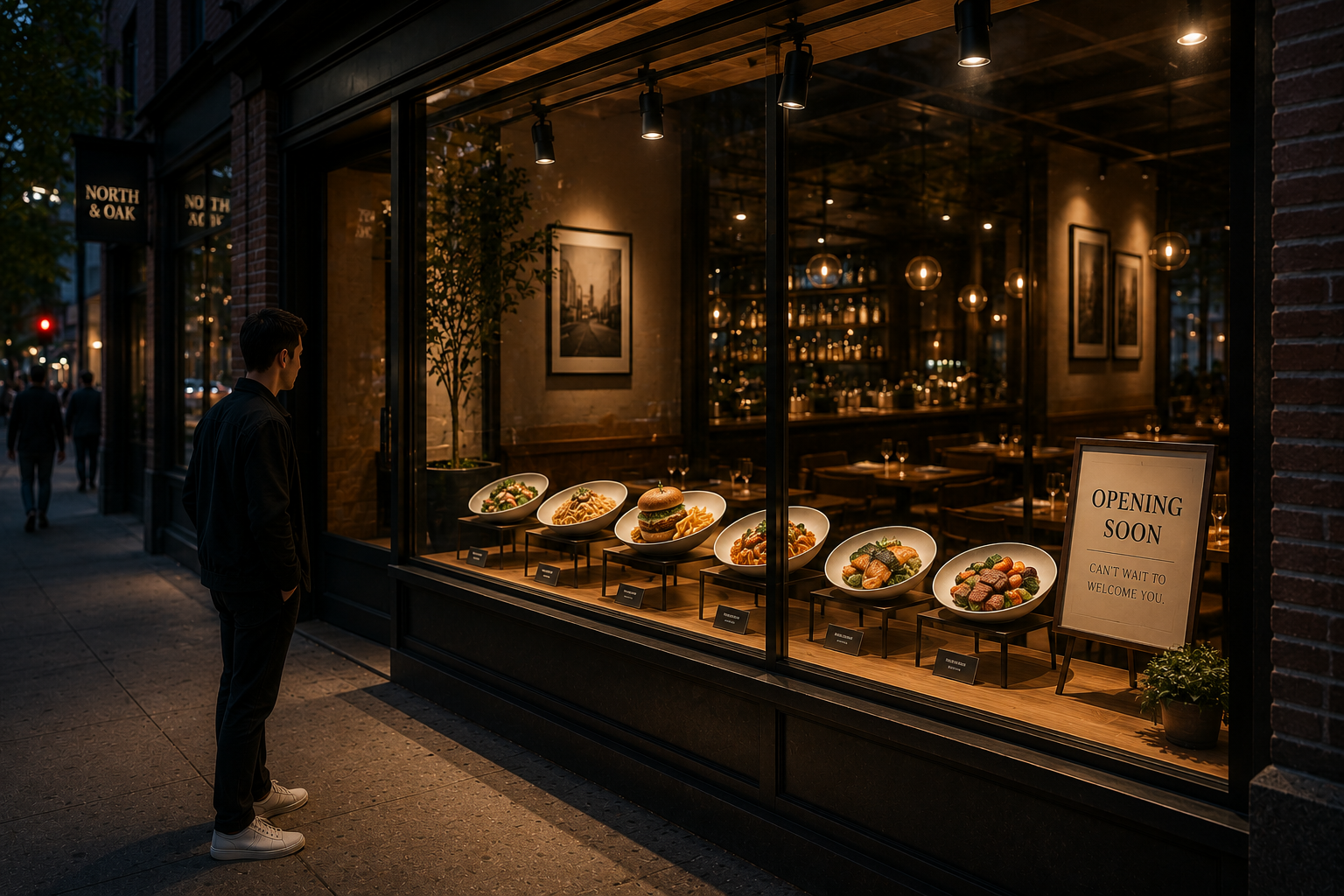
The short version: a restaurant's storefront starts advertising the moment you sign the lease. The only question is whether it is working for you or sitting blank. Retail research consistently shows people decide with their eyes, and a window can measurably lift foot traffic. This guide shows how to put a lit display of your real dishes in the window during build out, turning dead construction months into pre opening demand, and why the move is to commission it before day one rather than after.
First, the odds are better than you have heard, but visibility still decides
You have probably heard that 90 percent of restaurants fail in the first year. It is a myth. The figure traces back to an unsourced 2003 TV commercial. Independent research (UC Berkeley's Restaurant Mortality in the Western US) puts real first year closure closer to 17 percent, and the National Restaurant Association pegs the broader average near 30 percent. Roughly half of restaurants make it past five years.
So most new restaurants survive year one. The harder, more useful question is what separates the ones that thrive from the ones that limp along, and here the industry data keeps pointing at the same lever: getting seen. A 2025 dining trends report found that 55 percent of diners choose where to eat based on location and visibility, and weak marketing presence and low foot traffic show up again and again in failure post mortems. Your food can be excellent and still lose to the place with the window people cannot walk past.
That is the gap this guide addresses, and it lands during the one stretch of your restaurant's life when the whole neighborhood is already curious about your address.
Your storefront is advertising before you open, and the window does real work
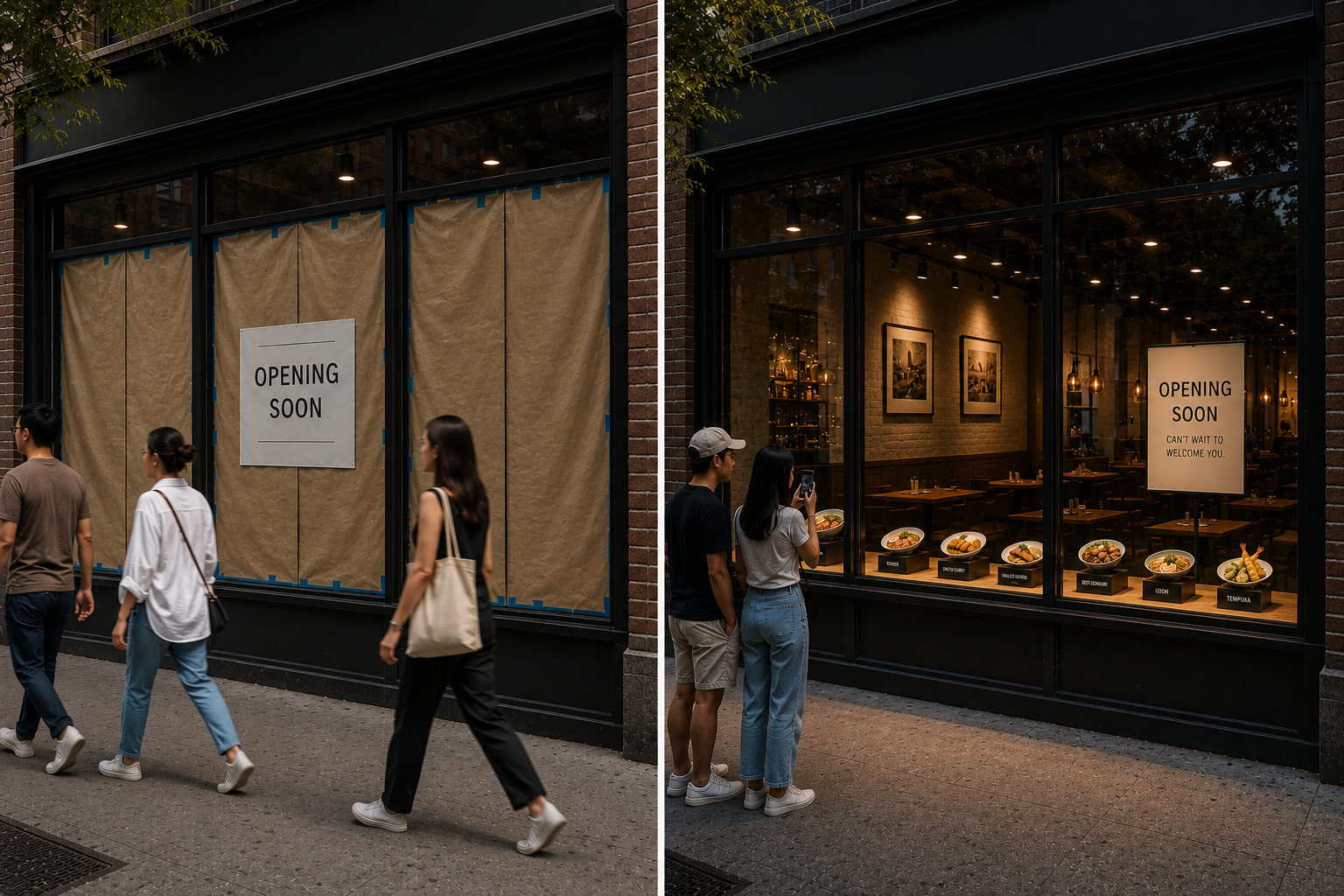
During build out, thousands of future customers walk past your paper covered glass and learn nothing. That is the most wasted marketing asset most owners have, because the research on visual merchandising is blunt about how much a window actually moves.
- Roughly 8 in 10 shoppers say what they see drives their buying decisions (Shop! Magazine).
- A well executed window display can lift foot traffic by around 23 percent (VM & Retail Magazine).
- Window displays influence a purchase decision about 24 percent of the time (NPD Research).
- A passerby decides whether to step in within roughly 2 to 3 seconds of sidewalk dwell time (industry display research, 2026).
Those numbers come from retail, where the effect has been studied longest, but restaurants are the purest version of the principle, because the product is the visual. The Japanese have a phrase for it: tasting with the eyes. A beautifully plated, lit dish in the window forms an opinion about your food before you have hired a server. Paper on the glass forms one too, just not the one you want.
Why food replicas, specifically
There are three ways to fill that window, and only one works all day, every day, for years. Real food spoils, wilts, browns, and attracts pests within hours, and displaying it outdoors runs straight into health codes. Printed signage and photos live on a flat surface your brain reads as advertising and filters out. A three dimensional replica reads as real food. It catches light, casts a shadow, and sits in the customer's actual space, which is the difference between "this place sells pasta" and "I want that bowl."
Lock in the display before day one: the two reasons
Both point to the same 3 to 5 month window.
Lead time (operational). Replicas are made to order. Each piece is hand sculpted and hand painted to match your exact plating from your notes, photos, and food samples, then shipped to you. That takes time, so the display has to be commissioned early enough to stand in the window while it still counts, during construction rather than after your grand opening.
Anticipation (strategic). Curiosity about a new address is a resource you can spend only once. A window that has been quietly selling your signature dish to the same commuters, dog walkers, and neighbors for two months means you do not open to strangers. You open to a crowd that already knows what they are coming for.
The 90 day countdown
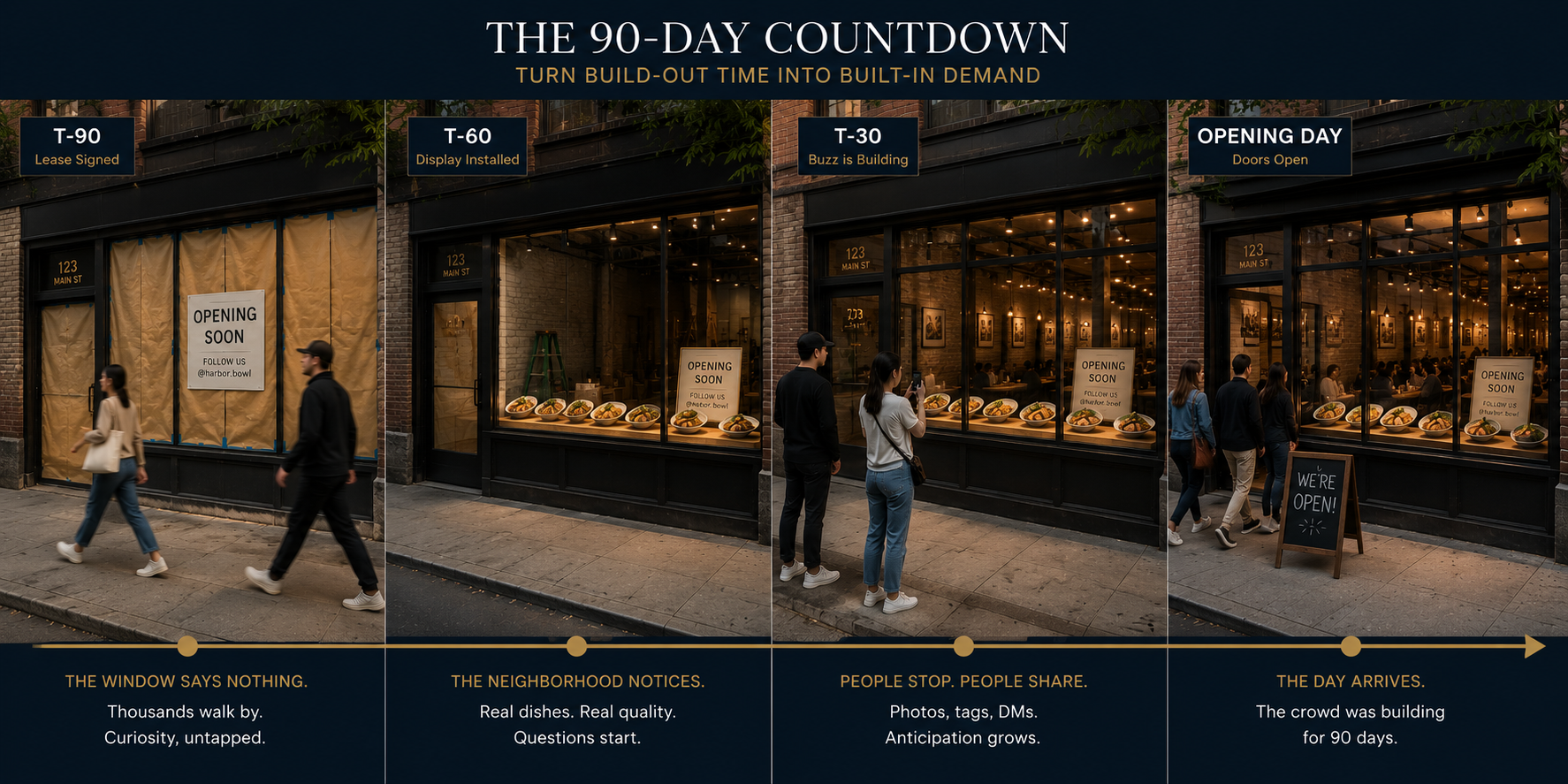
| Window | Do this | Why it matters |
|---|---|---|
| T-150 to T-90 3 to 5 months out | Lock your hero dishes (4 to 8 plates that define the concept) and commission the replicas from your plating notes and food samples. | Made to order pieces need lead time, and choosing signature dishes early forces menu clarity you want anyway. |
| T-90 to T-60 | Replicas in production. Finalize the window plan: placement, pedestals or a lit case, lighting, sightlines from the sidewalk. | The window is a stage. Eye level and lit beats flat on the sill. |
| T-60 to T-30 | Install the lit display during construction. Add an Opening Soon card with your handle and target date. | The sidewalk starts working for you. Every passerby becomes a pre opening impression. |
| T-30 to opening | Full display live. Film the "is it real?" content, run the countdown on social, tag the neighborhood, line up your soft open. | Convert months of curiosity into a following before the doors open. |
| Opening day | Open with a full, finished window, not a blank one. | You launch looking established, with a display that keeps selling for years to come. |
How to design a restaurant window display that stops people
Lead with your heroes, not the whole menu
Show the 4 to 8 dishes you most want to be known for. A tight, confident selection reads as a point of view. A cluttered one reads as noise.
Get it to eye level and light it
Products displayed at eye level are far more likely to be noticed and chosen (Retail TouchPoints puts it around 82 percent more likely to be picked up), and shoppers perceive well lit merchandise as meaningfully more valuable. Pedestals, risers, or a lit glass case bring the gloss and texture into view from across the street. A dish that catches light looks alive. A dish flat on the ledge looks like a prop.
Match the plating exactly
The entire effect depends on realism, so the replicas are sculpted and painted to your real plating: the char on the protein, the glisten of the sauce, the exact portion. Anything generic breaks the spell.
Keep it changeable
Menus evolve. Magnetic backed pieces let you swap the window in seconds without drilling or remounting, so the display grows with the menu instead of freezing on opening day.
Turn the build out into a content run
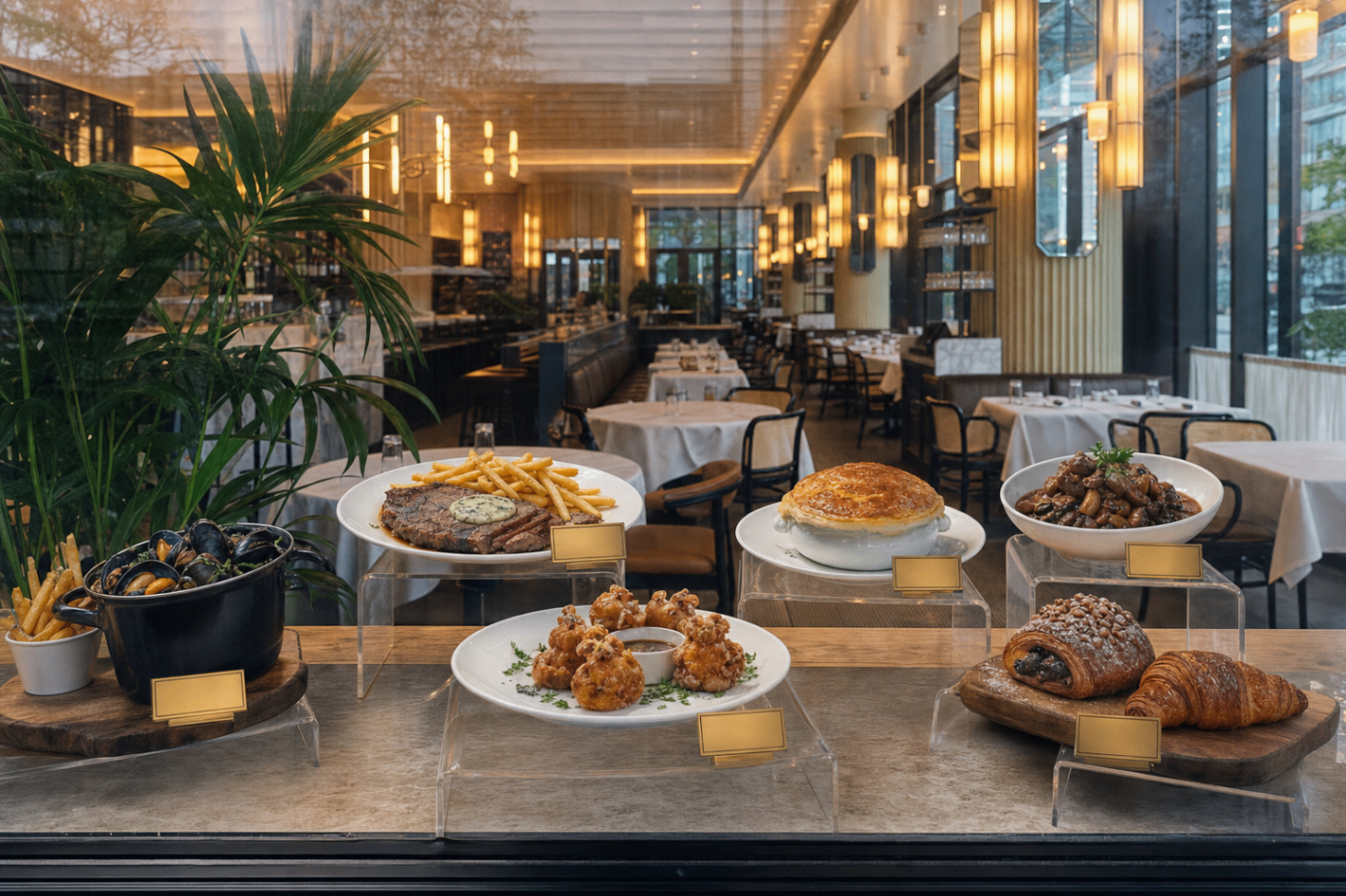
The pre opening window is also your best content run. Retail data shows share worthy, Instagrammable displays generate real word of mouth and free online exposure, and a hyperrealistic replica is built for the "wait, is that real?" video. During construction that clip does double duty: it shows off the food and it announces you are coming. Post the display going into the window, the countdown, the reveal. By opening day you have turned months of sidewalk curiosity into an audience that already knows your signature dish by sight. The same payback logic food truck operators run applies to a storefront.
An honest caveat
A window display is a high leverage, low cost lever, not a magic one. The restaurants that thrive still get the fundamentals right: menu market fit, disciplined cash flow (cash flow problems drive the large majority of business failures), a workable location, and consistent food and service. A great display in front of a concept that does not fit its market will not save it. What a display does do is make sure the concept you have worked hard on actually gets seen, remembered, and walked into, which, for a new restaurant fighting for early traffic, is often the difference between a slow first quarter and a full one. Regulars can account for up to 80 percent of a restaurant's profits, and you cannot convert a regular you never got in the door.
The bottom line
Your storefront advertises the entire time you are building. The only choice is what it says. A lit display of your real dishes, commissioned early enough to stand in the window through construction, turns dead build out months into free anticipation, opens you to a crowd instead of strangers, and keeps selling from the sidewalk for ten plus years after. Lock it in before day one.
Interactive
Run your own ROI.
Slide the values to match your restaurant. The math updates live.
Rough guidance only. Real lift depends on foot traffic, menu, and how visible the display is.
Interactive planner
When should you start?
Pick your target opening date. The plan updates live.
- Commission the displayOct 15, 2026 · 1 days ago
Lock hero dishes, send plating photos and samples.
- Install in the windowDec 14, 2026 · in 59 days
Lit case or pedestals, eye level, Opening Soon card.
- Start the countdown onlineJan 13, 2027 · in 89 days
Film the is it real content, tag the neighborhood.
- Doors openFeb 12, 2027
Open to a crowd, not to strangers.
Frequently asked questions
Sources
- UC Berkeley, Restaurant Mortality in the Western US, and the National Restaurant Association: restaurant failure and survival rates.
- 2025 dining trends reporting: 55 percent of diners choose based on location and visibility.
- Shop! Magazine, VM & Retail Magazine, Retail TouchPoints, and NPD Research: visual merchandising and window display effect data.
- JAPAN HOUSE Los Angeles and public archives on Takizo Iwasaki: history and craft of shokuhin sampuru.
About the author
The Custom Food Replica team is the authorized US distributor and official partner of Iwasaki, the Japanese house that invented modern shokuhin sampuru in 1932. We design and supply hyperrealistic food displays for U.S. restaurants, food trucks, and pre opening venues, with every piece hand sculpted and hand painted in Japan to match a client's exact dishes, then shipped nationwide.
Keep reading