
Buyer's Guide · Displays
How to Make a Fake Food Display: A Restaurant Buyer's Guide
By the Custom Food Replica team · Authorized US distributor & official partner of Iwasaki, Japan's original food replica makers.
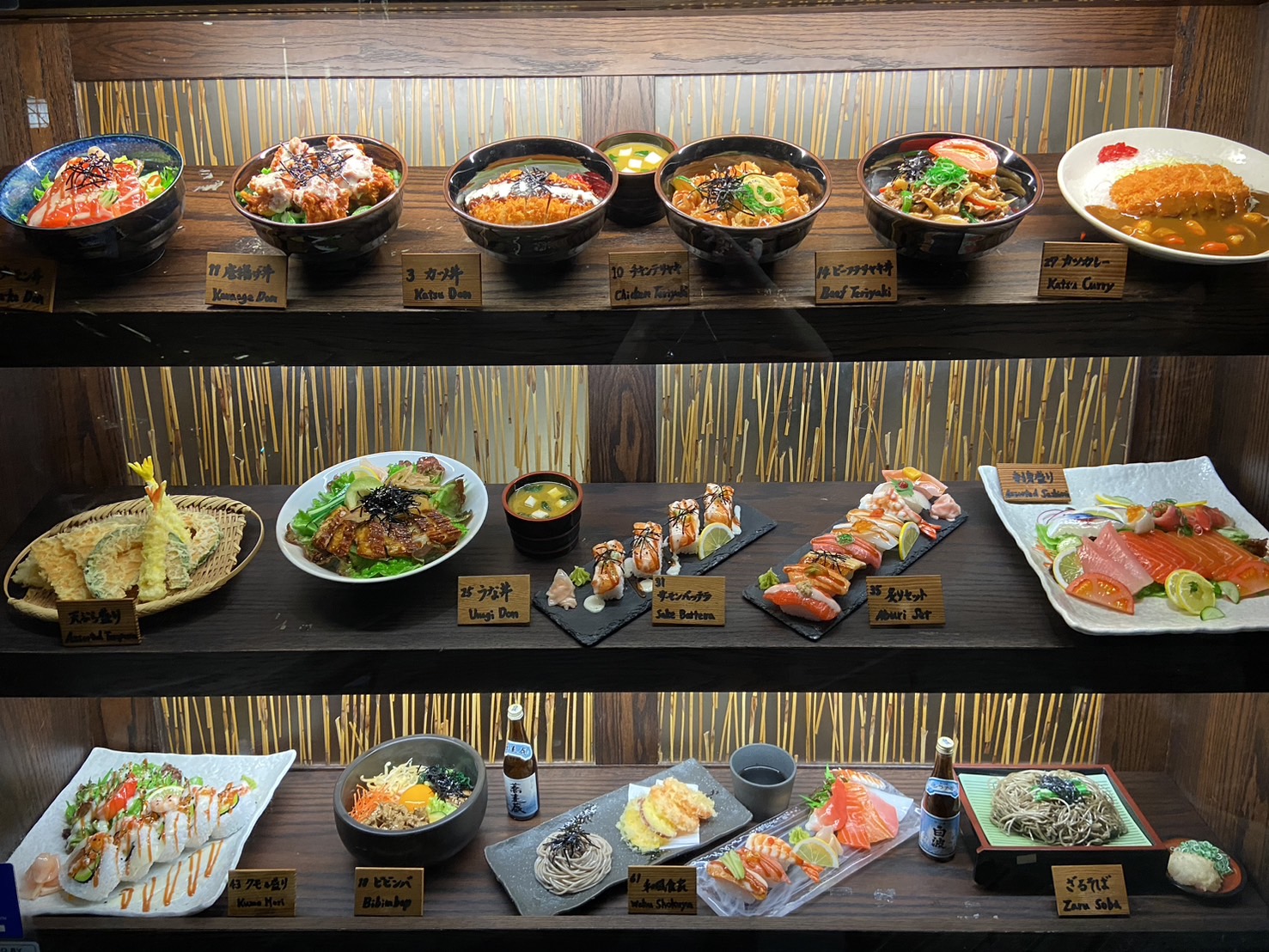
The short version: A fake food display is one of the few marketing investments that works 24 hours a day, needs almost no upkeep, and lasts for years. But most displays underperform for avoidable reasons: the wrong dishes, the wrong height, bad lighting, or pieces too generic to convince anyone. This guide walks through the decisions in order, from measuring your space to choosing dishes, layout, lighting, and mounting, so the display you buy actually pulls people through the door.
What is a fake food display?
A fake food display is an arrangement of realistic, non-edible food models used to show customers what you serve. You'll see the same thing called display fake foods, imitation food for display, replica food, or by its original Japanese name, shokuhin sampuru. The pieces are made from resin, PVC, and silicone, then hand-painted to look like real dishes, and they're placed in a window, a case, or on a counter where customers can see them before they order.
The reason they work is simple. People decide with their eyes, and a three-dimensional dish sitting in someone's actual space registers as food in a way a photograph never does. It also solves the practical problem real food can't: no spoilage, no refrigeration, no waste, no pests, and no health-code trouble from leaving food out on display.
Step 1: Decide what the display has to do
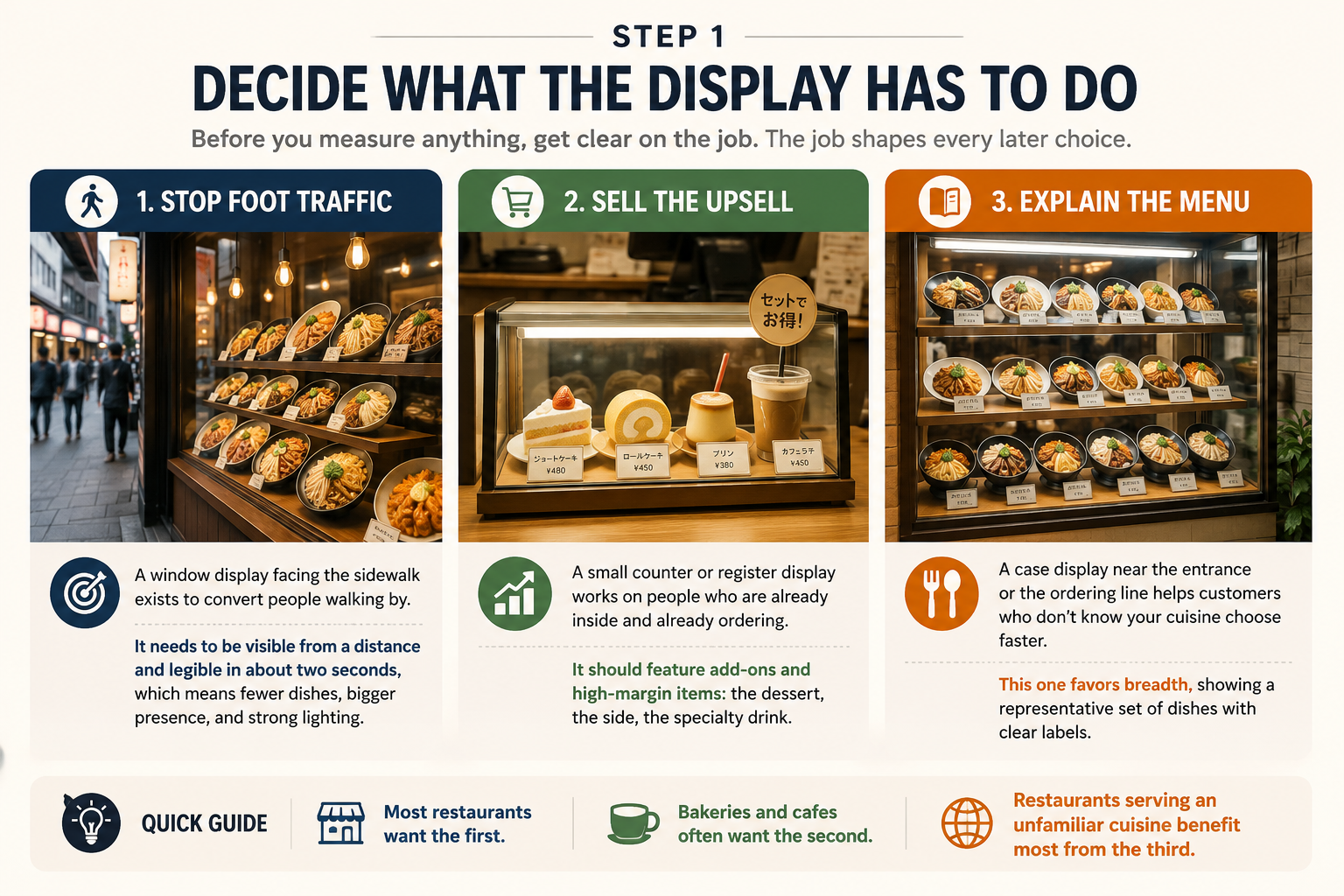
Before you measure anything, get clear on the job. Displays generally do one of three things, and the job shapes every later choice.
Stop foot traffic. A window display facing the sidewalk exists to convert people walking by. It needs to be visible from a distance and legible in about two seconds, which means fewer dishes, bigger presence, and strong lighting.
Sell the upsell. A small counter or register display works on people who are already inside and already ordering. It should feature add-ons and high-margin items: the dessert, the side, the specialty drink.
Explain the menu. A case display near the entrance or the ordering line helps customers who don't know your cuisine choose faster. This one favors breadth, showing a representative set of dishes with clear labels, which is exactly the role these displays play across Japan.
Most restaurants want the first. Bakeries and cafes often want the second. Restaurants serving an unfamiliar cuisine benefit most from the third.
Step 2: Measure your space before you choose dishes
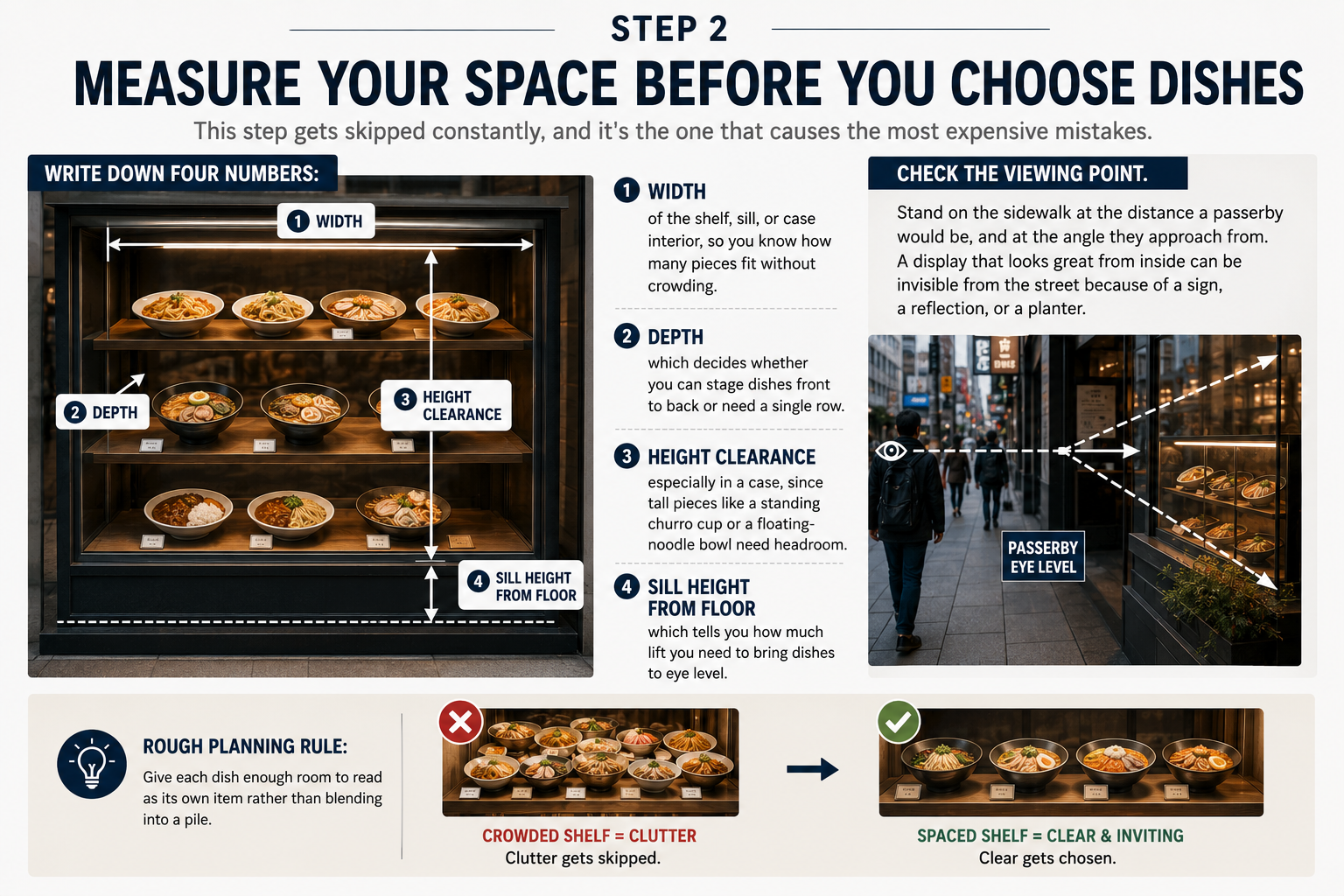
This step gets skipped constantly, and it's the one that causes the most expensive mistakes. Write down four numbers:
- Width of the shelf, sill, or case interior, so you know how many pieces fit without crowding.
- Depth, which decides whether you can stage dishes front to back or need a single row.
- Height clearance, especially in a case, since tall pieces like a standing churro cup or a floating-noodle bowl need headroom.
- Sill height from the floor, which tells you how much lift you need to bring dishes to eye level.
Then note where people actually see it from. Stand on the sidewalk at the distance a passerby would be, and at the angle they approach from. A display that looks great from inside can be invisible from the street because of a sign, a reflection, or a planter.
As a rough planning rule, give each dish enough room to read as its own item rather than blending into a pile. A crowded shelf reads as clutter, and clutter gets skipped.
Step 3: Choose the right dishes (this decides everything)
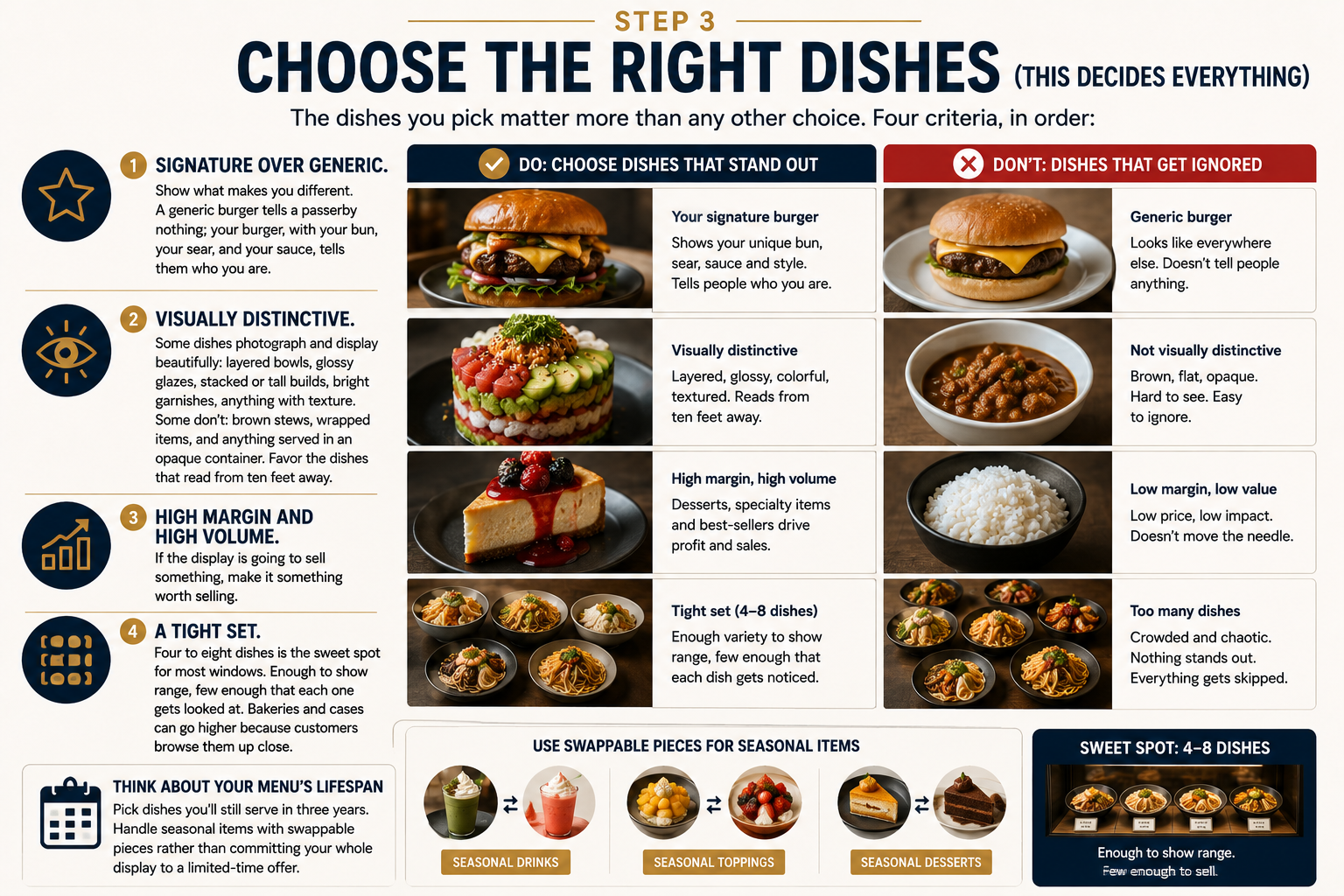
The dishes you pick matter more than any other choice. Four criteria, in order:
- Signature over generic. Show what makes you different. A generic burger tells a passerby nothing; your burger, with your bun, your sear, and your sauce, tells them who you are.
- Visually distinctive. Some dishes photograph and display beautifully: layered bowls, glossy glazes, stacked or tall builds, bright garnishes, anything with texture. Some don't: brown stews, wrapped items, and anything served in an opaque container. Favor the dishes that read from ten feet away.
- High margin and high volume. If the display is going to sell something, make it something worth selling.
- A tight set. Four to eight dishes is the sweet spot for most windows. Enough to show range, few enough that each one gets looked at. Bakeries and cases can go higher because customers browse them up close.
One more consideration: think about your menu's lifespan. Pick dishes you'll still serve in three years, and handle seasonal items with swappable pieces rather than committing your whole display to a limited-time offer.
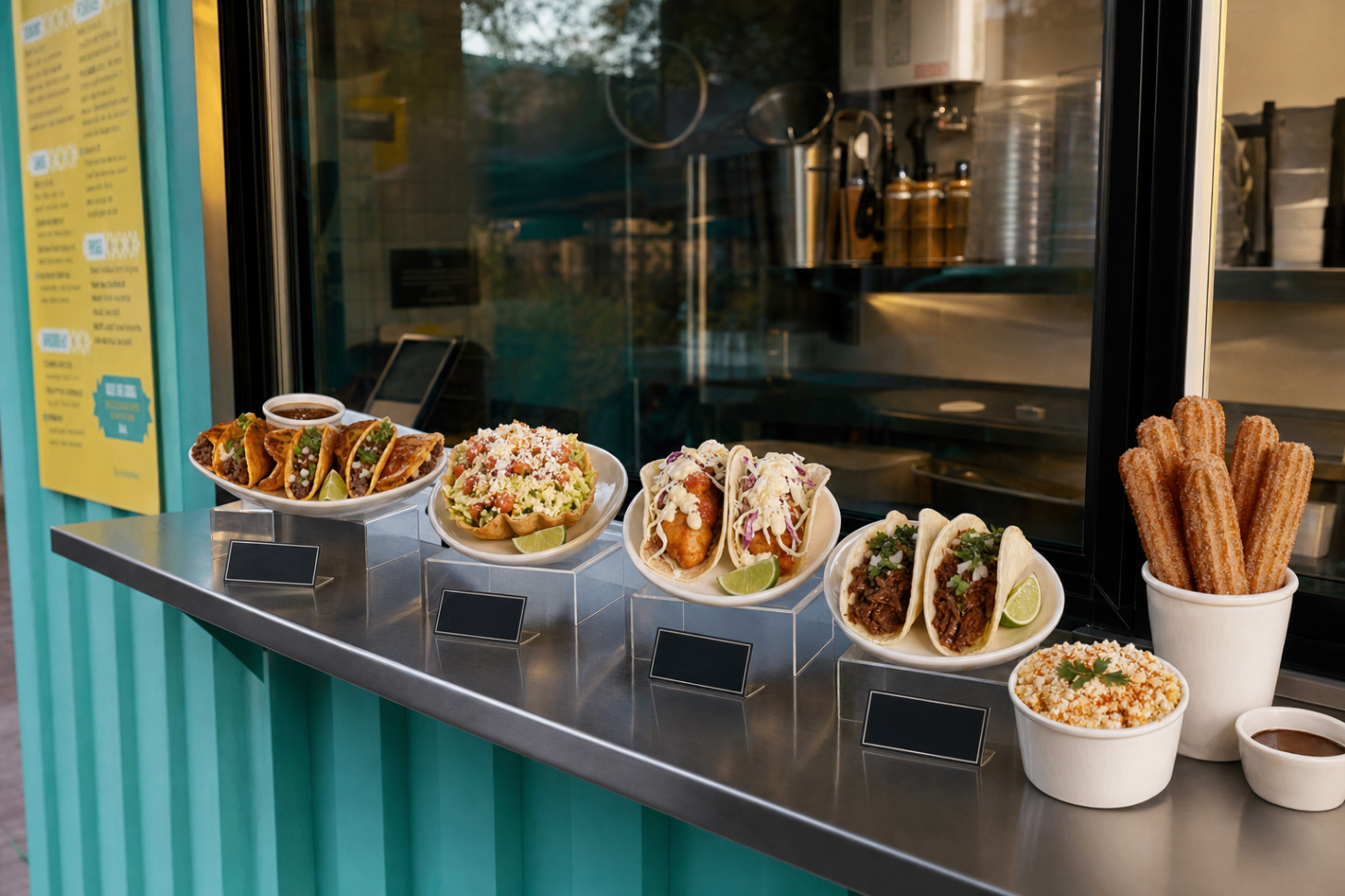
Step 4: Plan the layout and, above all, the height
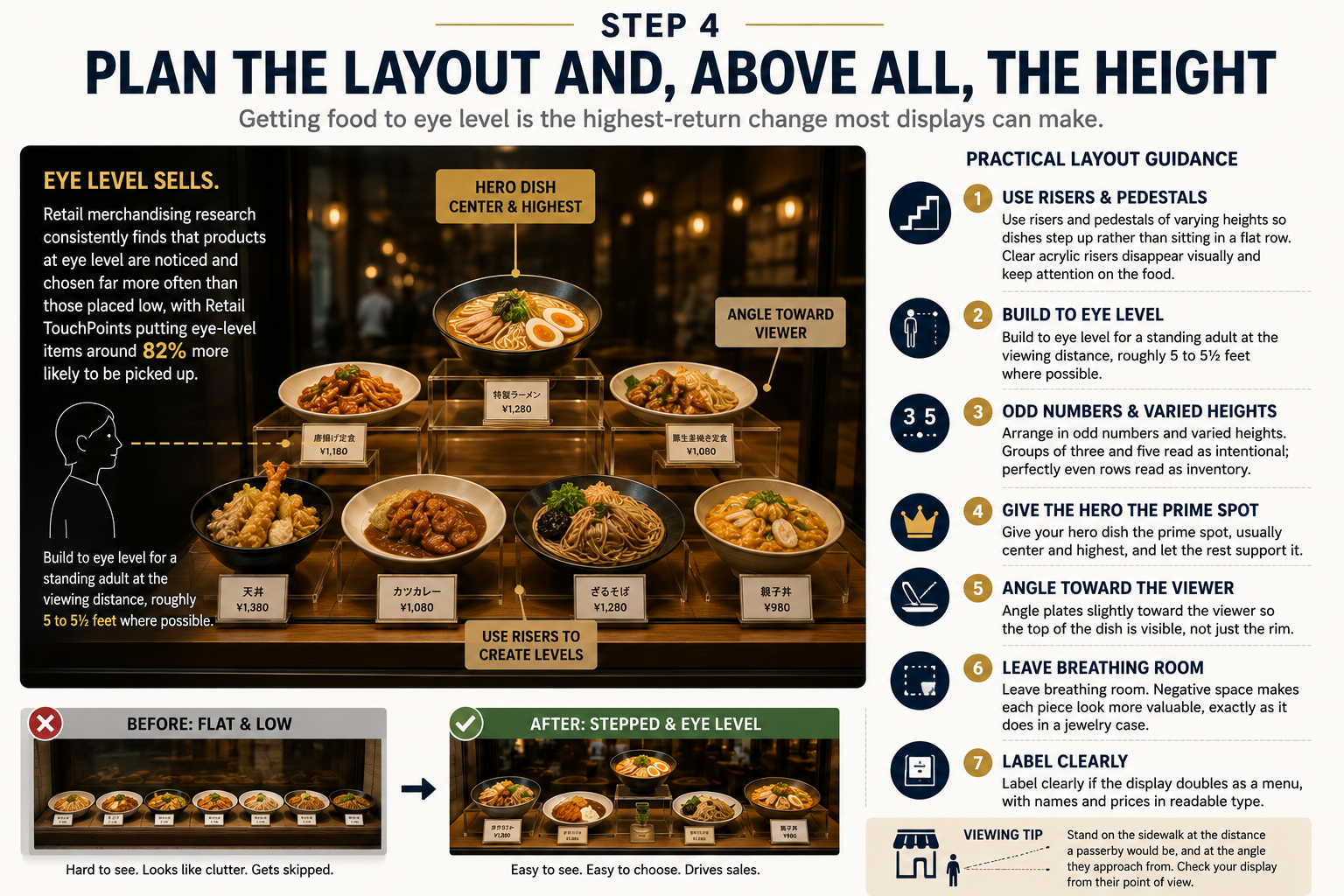
Getting food to eye level is the highest-return change most displays can make. Retail merchandising research consistently finds that products at eye level are noticed and chosen far more often than those placed low, with Retail TouchPoints putting eye-level items around 82% more likely to be picked up. A dish sitting flat on a low sill is out of the sightline of everyone walking past.
Practical layout guidance:
- Use risers and pedestals of varying heights so dishes step up rather than sitting in a flat row. Clear acrylic risers disappear visually and keep attention on the food.
- Build to eye level for a standing adult at the viewing distance, roughly 5 to 5 and a half feet where possible.
- Arrange in odd numbers and varied heights. Groups of three and five read as intentional; perfectly even rows read as inventory.
- Give your hero dish the prime spot, usually center and highest, and let the rest support it.
- Angle plates slightly toward the viewer so the top of the dish is visible, not just the rim.
- Leave breathing room. Negative space makes each piece look more valuable, exactly as it does in a jewelry case.
- Label clearly if the display doubles as a menu, with names and prices in readable type.
Step 5: Light it properly
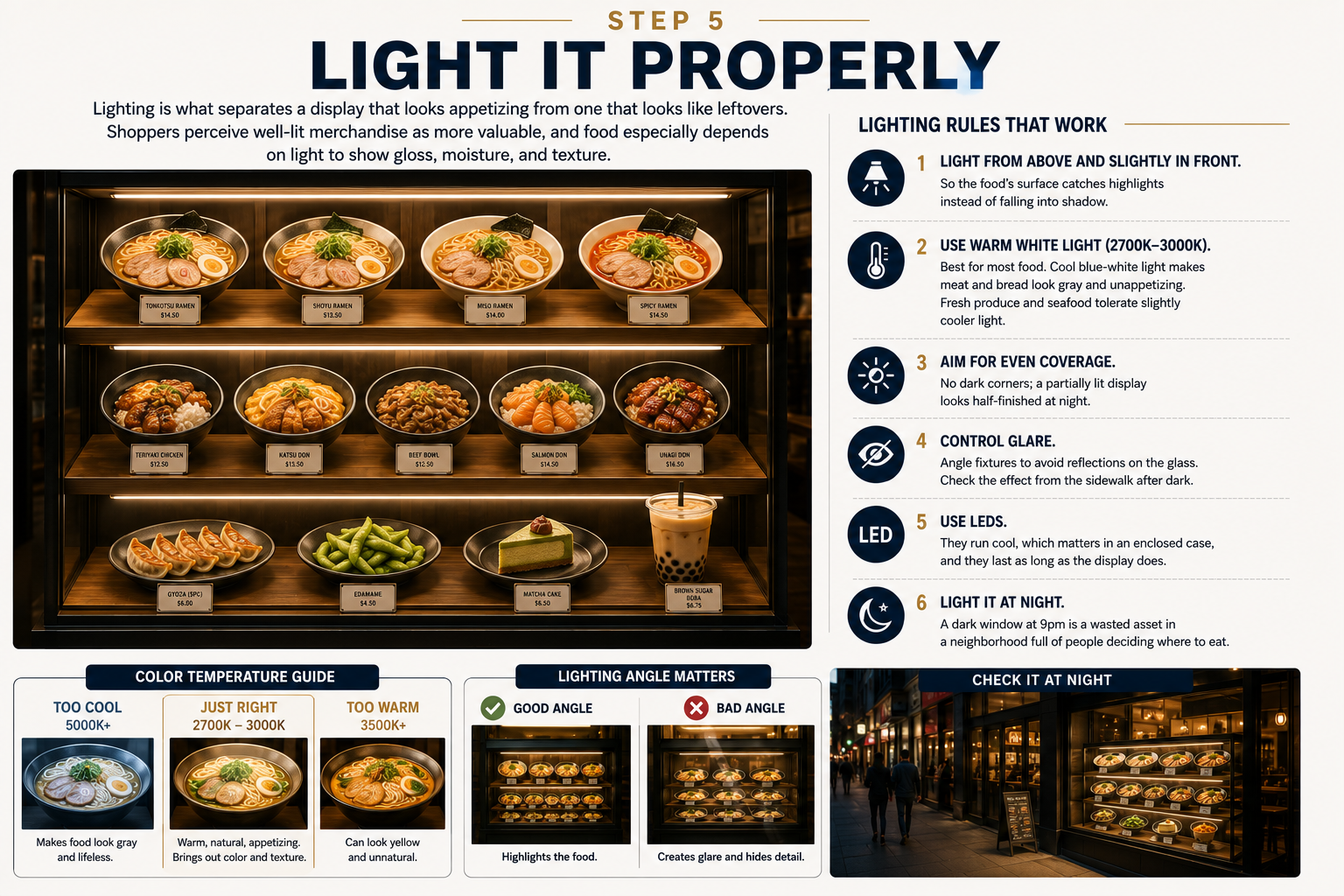
Lighting is what separates a display that looks appetizing from one that looks like leftovers. Shoppers perceive well-lit merchandise as more valuable, and food especially depends on light to show gloss, moisture, and texture.
A few rules that hold up in practice:
- Light from above and slightly in front, so the food's surface catches highlights instead of falling into shadow.
- Use warm white light in the 2700K to 3000K range for most food. Cool blue-white light makes meat and bread look gray and unappetizing. Fresh produce and seafood tolerate slightly cooler light.
- Aim for even coverage with no dark corners; a partially lit display looks half-finished at night.
- Control glare. If you're behind glass, angle the fixtures so they don't reflect back at the viewer, and check the effect from the sidewalk after dark.
- Use LEDs. They run cool, which matters in an enclosed case, and they last as long as the display does.
- Light it at night. A dark window at 9pm is a wasted asset in a neighborhood full of people deciding where to eat.
Step 6: Choose the right quality, not the cheapest option
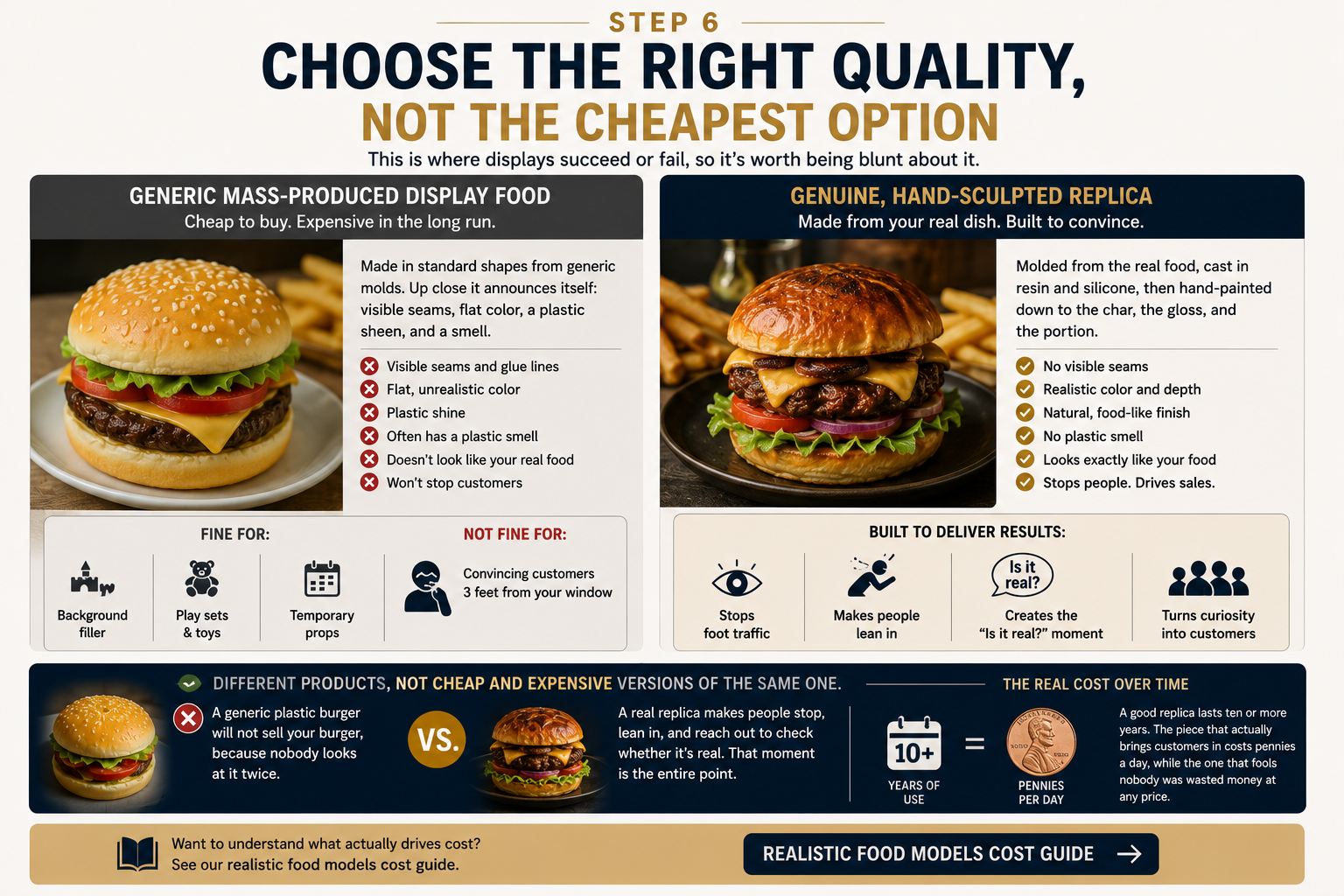
This is where displays succeed or fail, so it's worth being blunt about it.
There are two very different products sold under the name “fake food.” Generic mass-produced display food is made in standard shapes from generic molds, and up close it announces itself: visible seams, flat color, a plastic sheen, and a smell. It's fine for background filler, a play set, or a temporary prop. What it cannot do is convince a customer standing three feet from your window that they're looking at your food.
The other product is a genuine, hand-sculpted replica made from your actual dish: molded from the real food, cast in resin and silicone, then hand-painted down to the char, the gloss, and the portion. That's the piece that makes someone stop, lean in, and reach out to check whether it's real. That “is it real?” moment is the entire point of the display, and it only comes from real craft.
They are different products, not cheap and expensive versions of the same one. A generic plastic burger will not sell your burger, because nobody looks at it twice. Judged across the ten or more years a good replica lasts, the piece that actually brings customers in costs pennies a day, while the one that fools nobody was wasted money at any price. For a deeper dive on what actually drives cost, see our realistic food models cost guide.
Step 7: Plan for mounting and change
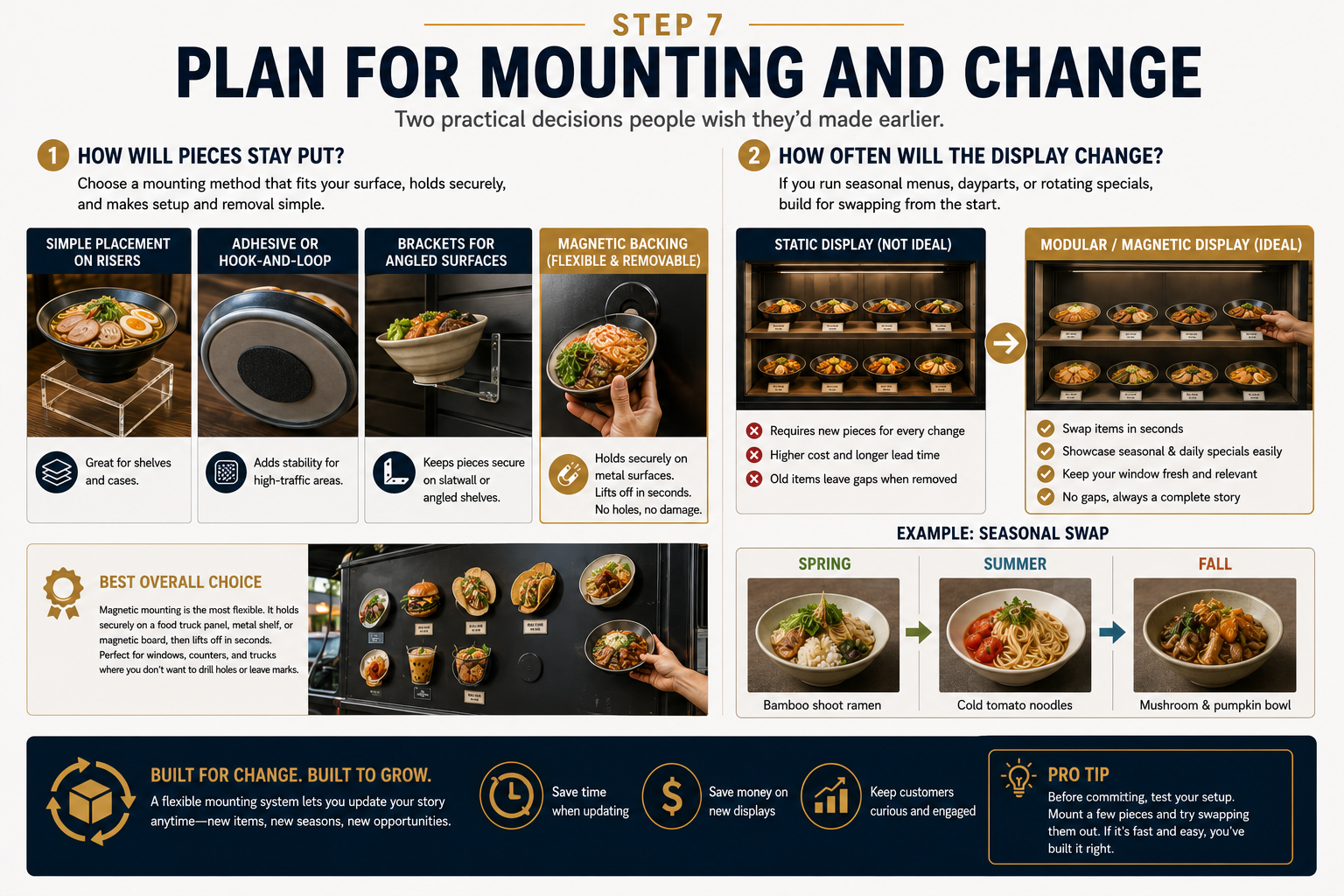
Two practical decisions people wish they'd made earlier.
How will pieces stay put? Options include simple placement on risers, adhesive or hook-and-loop for stability, brackets for angled surfaces, and magnetic backing for metal surfaces or magnetic boards. Magnetic mounting is the most flexible: pieces hold securely on a truck panel or a metal shelf, then lift off in seconds without drilling holes in your window or counter.
How often will the display change? If you run seasonal menus, dayparts, or rotating specials, build for swapping from the start. A magnetic or modular setup lets you change the story in the window without commissioning a new display each time, and it means a limited-time item can appear and disappear without leaving a gap.
Step 8: Maintenance (there almost isn't any)
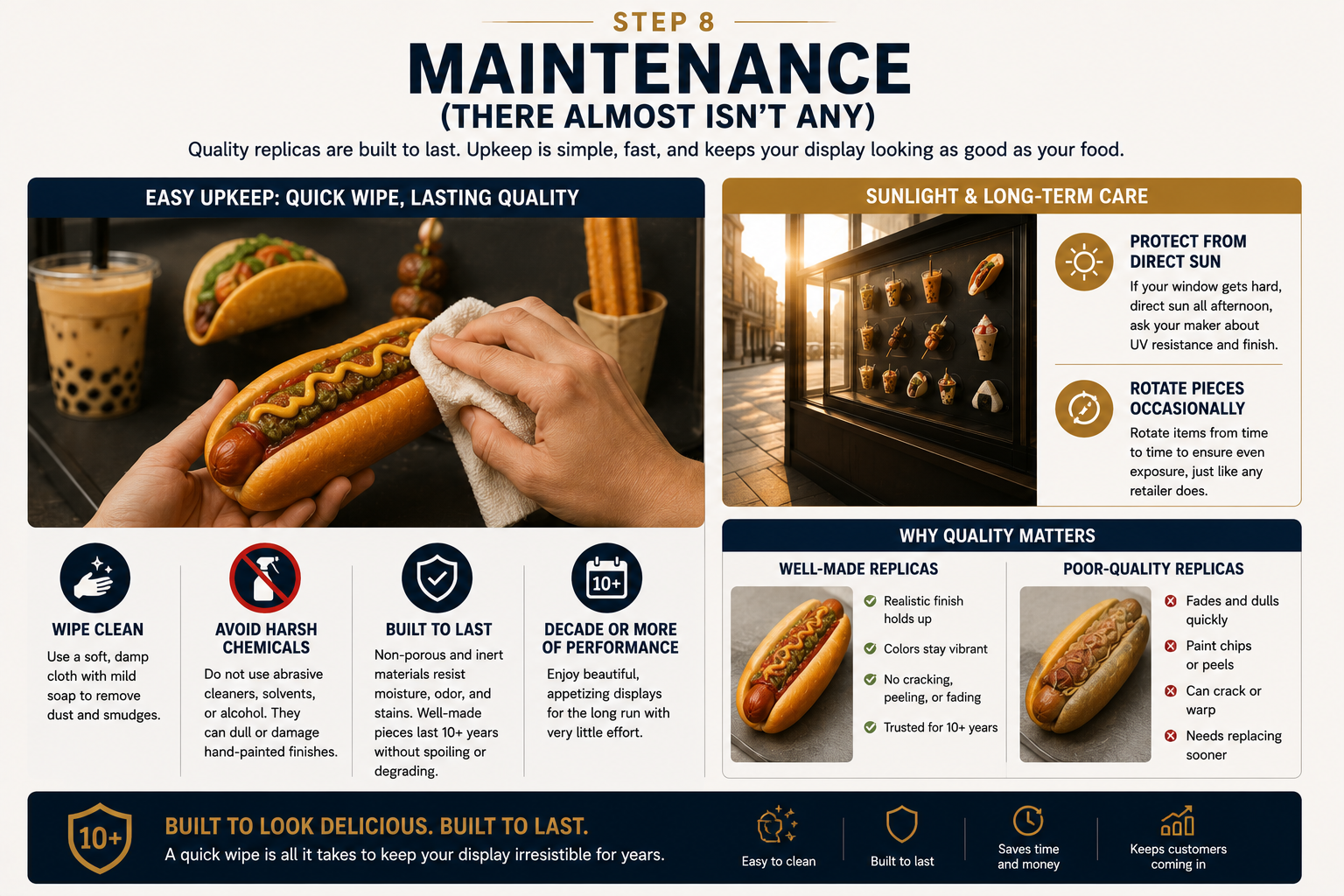
This is the easy part. Quality replicas are non-porous and inert, so upkeep is a wipe with a soft, damp cloth and mild soap when dust builds up. Avoid abrasive cleaners and solvents, which can dull hand-painted finishes. Well-made pieces typically last 3 to 5 years, and often a decade or more, without spoiling or degrading. If your window gets hard, direct sun all afternoon, ask your maker about UV resistance and finish, and rotate pieces occasionally, the same way any retailer treats a sun-facing display.
Common mistakes to avoid
- Too many dishes. Clutter reads as noise, and nothing gets seen.
- Everything at one height, which flattens the display and hides the back row.
- No lighting, or cold lighting, which makes good food look unappetizing.
- Generic pieces that don't match what you actually serve, which confuses customers and cheapens the brand.
- Placing it below the sightline, so passersby never register it.
- Forgetting the night view, when a lit window has the least competition for attention.
- Choosing a dish you're about to remove from the menu.
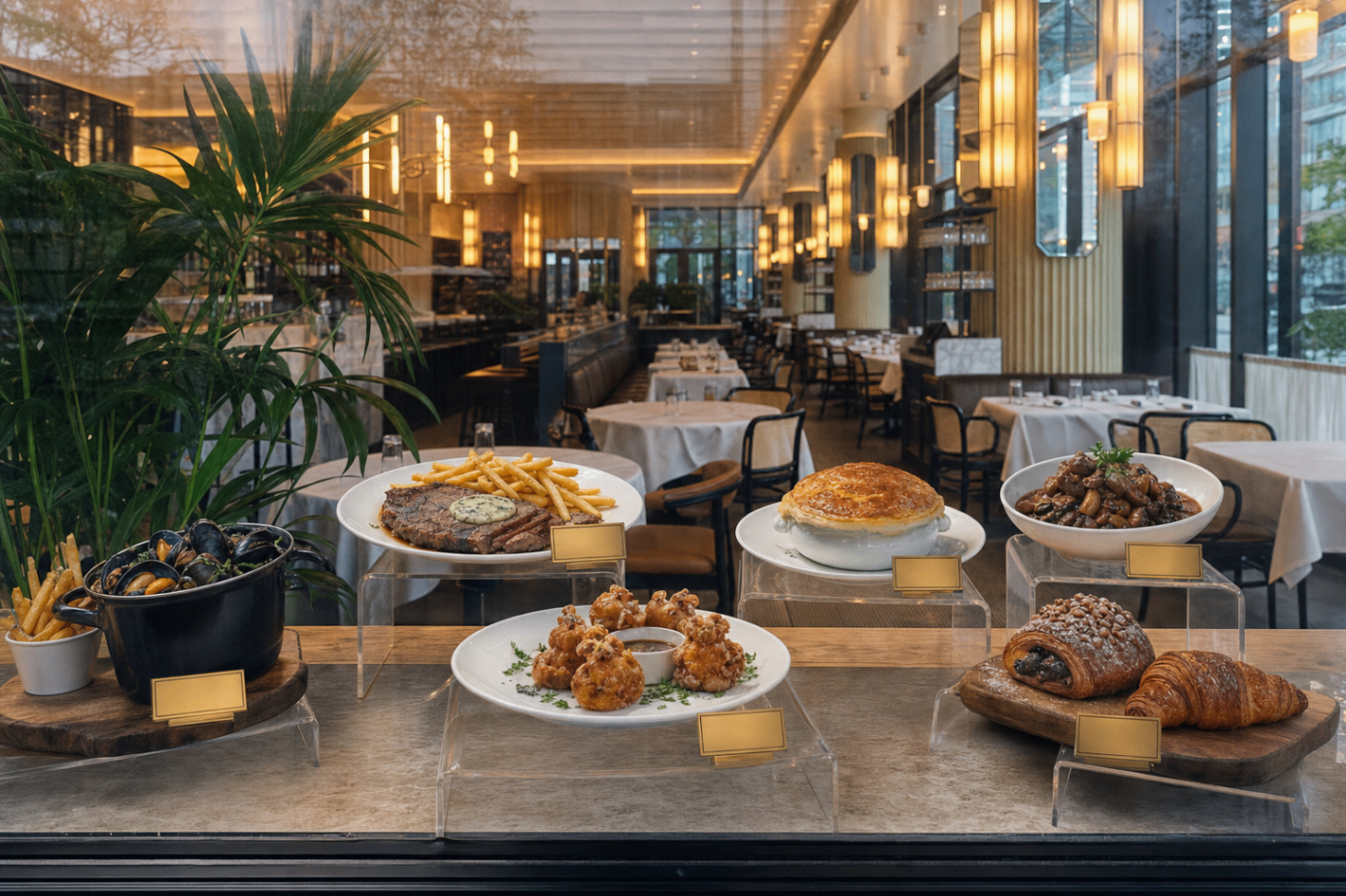
How a custom display comes together with CFR
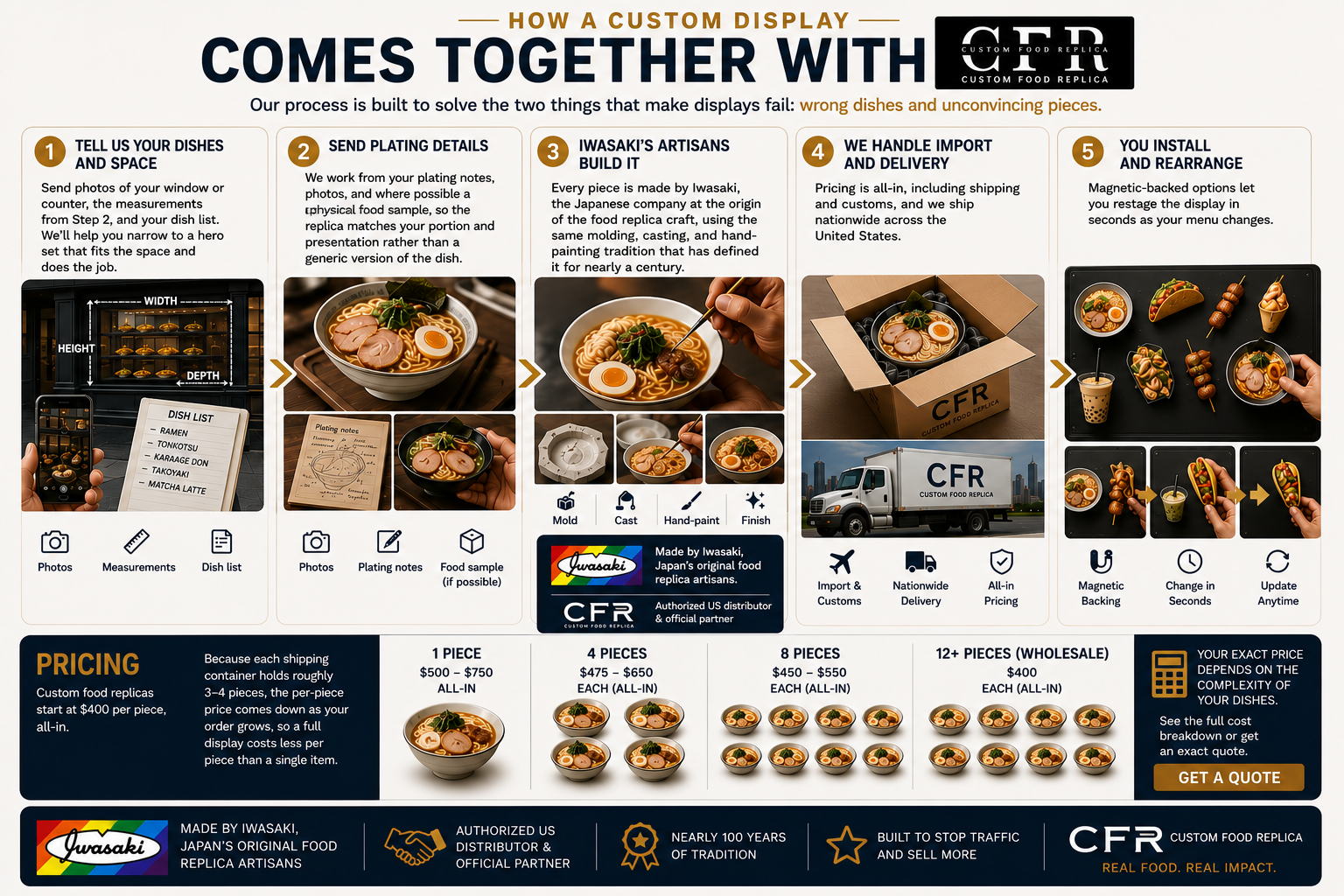
Our process is built to solve the two things that make displays fail, which are wrong dishes and unconvincing pieces.
- Tell us your dishes and space. Send photos of your window or counter, the measurements from Step 2, and your dish list. We'll help you narrow to a hero set that fits the space and does the job.
- Send plating details. We work from your plating notes, photos, and where possible a physical food sample, so the replica matches your portion and presentation rather than a generic version of the dish.
- Iwasaki's artisans build it. Every piece is made by Iwasaki, the Japanese company at the origin of the food replica craft, using the same molding, casting, and hand-painting tradition that has defined it for nearly a century. Custom Food Replica is their authorized US distributor and official partner.
- We handle import and delivery. Pricing is all-in, including shipping and customs, and we ship nationwide across the United States.
- You install and rearrange. Magnetic-backed options let you restage the display in seconds as your menu changes.
Pricing. Custom food replicas start at $400 per piece, all-in. Because each shipping container holds roughly three to four pieces, the per-piece price comes down as your order grows, so a full display costs less per piece than a single item. Typical all-in ranges run from $500 to $750 for a single piece down to $400 each at wholesale volume. Your exact price depends on the complexity of your dishes. See the full cost breakdown or get an exact quote.
The bottom line
A fake food display is a long-term asset, so the decisions worth spending time on are the ones you can't easily undo: the space it lives in, the dishes you choose, the height you show them at, and whether the pieces are convincing enough to make someone stop. Get those right and the display sells for you every hour you're open, and every hour you're closed too.
From $400 per piece, all-in.
Custom replicas matched to your exact dishes. Shipping and customs included.
Frequently asked questions
- What is a fake food display?
- A fake food display is an arrangement of realistic, non-edible food models, also called display fake foods or imitation food for display, used in a window, case, or counter to show customers what you serve without using real food that spoils.
- How many dishes should a display include?
- Four to eight works for most restaurant windows: enough to show range, few enough that each dish gets noticed. Bakery and deli cases, which customers browse up close, can hold more.
- How do I choose which dishes to display?
- Pick signature items over generic ones, favor dishes that read well visually (layered, glossy, tall, colorful), prioritize high-margin sellers, and choose dishes you'll still serve in a few years.
- Where should the display be positioned?
- At eye level for a standing adult, viewed from where customers actually approach. Retail research finds eye-level products are far more likely to be noticed and chosen, so use risers to lift dishes off a low sill.
- What kind of lighting works best?
- Warm white LEDs around 2700K to 3000K, aimed from above and slightly in front, with even coverage and no glare on the glass. Keep it lit after dark, when a bright window has the least competition.
- How do I clean and maintain a fake food display?
- Wipe with a soft, damp cloth and mild soap. Avoid abrasive cleaners and solvents that can dull the hand-painted finish. There's no other routine upkeep.
- How long does a fake food display last?
- With normal care, quality replicas typically last 3 to 5 years, and well-maintained pieces can last 10 or more, without spoiling or fading. For a window in hard, direct sun, ask about UV resistance and rotate pieces occasionally.
- Can I change the display when my menu changes?
- Yes. Magnetic-backed pieces let you swap and restage the display in seconds, with no drilling and no remounting, so seasonal items and dayparts are easy to handle.
- How much does a custom fake food display cost?
- Custom replicas start at $400 per piece all-in, including shipping and customs, with the per-piece price decreasing at higher quantities. A full display is quoted to your specific dishes.
About the author
Custom Food Replica is the authorized US distributor and official partner of Iwasaki, the Japanese maker at the origin of the shokuhin sampuru food replica craft. We build hyperrealistic, made-to-order food displays for U.S. restaurants, bakeries, food trucks, and retailers, each sculpted and hand-painted to match a client's exact dishes and shipped nationwide.
Sources
- Retail TouchPoints: eye-level product placement and likelihood of selection.
- VM & Retail Magazine and Shop! Magazine: window display effect on foot traffic and the role of visual decision-making.
- Retail lighting guidance: color temperature recommendations for food merchandising and perceived product value.
- Fake food buying guides (2026): quality indicators in mass-produced versus handcrafted display food.
Related reading: realistic food models cost guide, the 90 day restaurant launch playbook, and the food truck menu ROI breakdown.