
Comparison · Displays
Fake Food vs Real Food for Display: Which Should You Use?
By the Custom Food Replica team · Authorized US distributor & official partner of Iwasaki, Japan's original food replica makers.
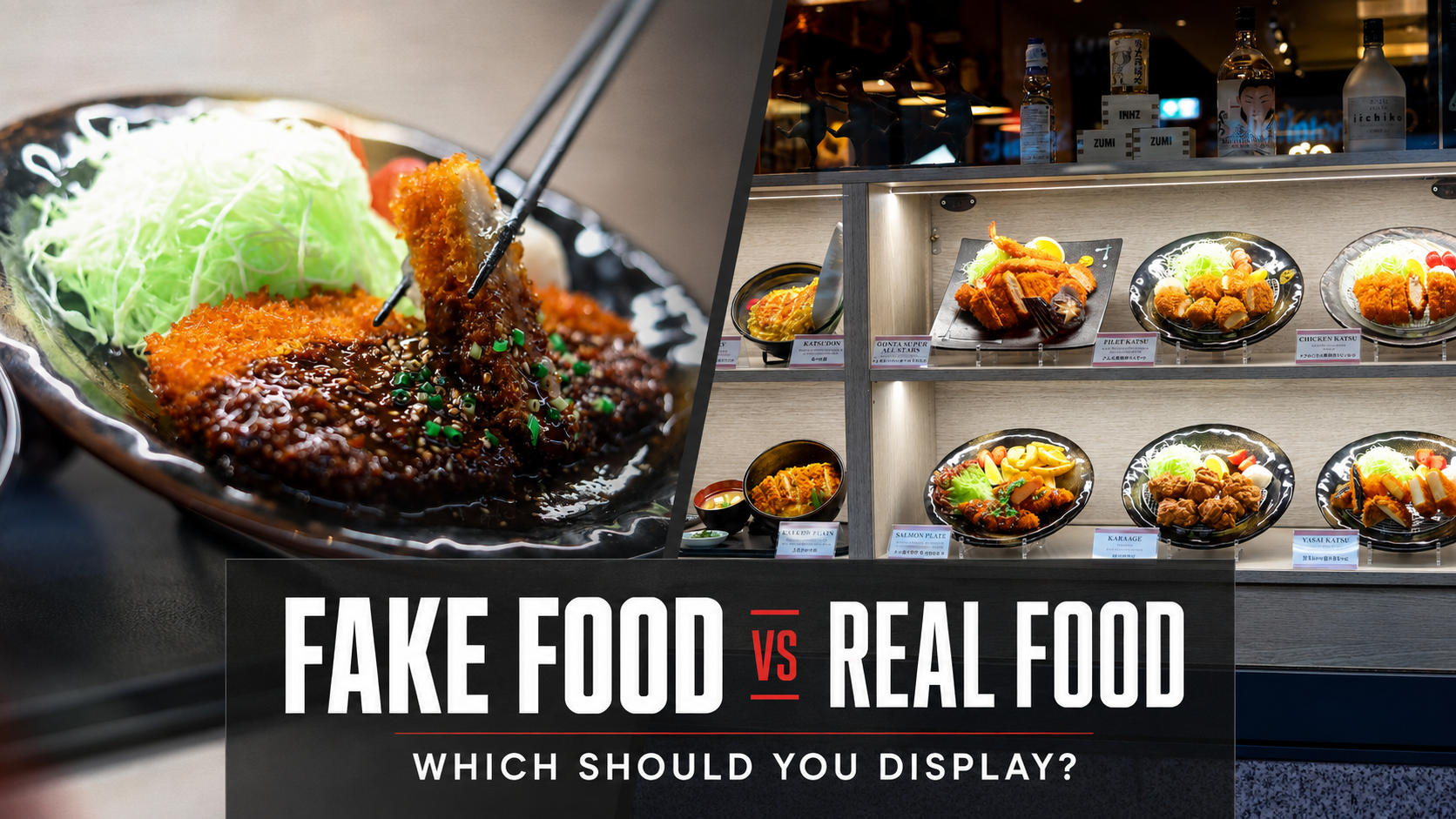
Quick answer
For food that will be eaten or tasted, use real food. For food that is only displayed, such as a window, counter, case, or prop, use fake food. Real food left out becomes unsafe within about two hours under FDA guidance, wilts within the hour, and has to be re-plated or thrown away daily. A replica holds the same plated look for years with no spoilage, no health-code issue, and no waste. The two are suited to different jobs, not to the same job at different prices.
Key facts
- Real food held without temperature control should be discarded after about 2 hours, or 1 hour above 90°F (FDA/USDA).
- Food replicas do not spoil, wilt, or fade, and hold their plated look for 3 to 5 years indoors, and 10 years or more when well maintained.
- A display made from real food creates daily waste and re-plating labor. A replica display creates neither.
- Custom Food Replica is the authorized US distributor and official partner of Iwasaki, the origin of the craft.
Fake food vs real food: the comparison
The choice comes down to one question: will the food be eaten, or only seen? Here is how the two compare on the things that actually matter for a display.
| Criteria | Real food (for display) | Fake food (replicas) | Source |
|---|---|---|---|
| Time it stays safe and looks right, unrefrigerated | About 2 hours, then discard (1 hour above 90°F) | 3 to 5 years indoors, 10+ with care | FDA / USDA |
| Open, unrefrigerated display | Restricted, and a food-safety risk | Compliant: inert and non-porous | FDA Food Code |
| Appearance across a day | Wilts, browns, melts, or dries within the hour | Identical from open to close | — |
| Pests and odor | Attracts both | Neither | — |
| Ongoing cost | Recurring: re-plate or replace, often daily | One-time purchase | — |
| Daily labor | Re-plating and disposal every day | An occasional wipe-down | — |
| Best for | Food that will be eaten or tasted | Food that is shown but not eaten | — |
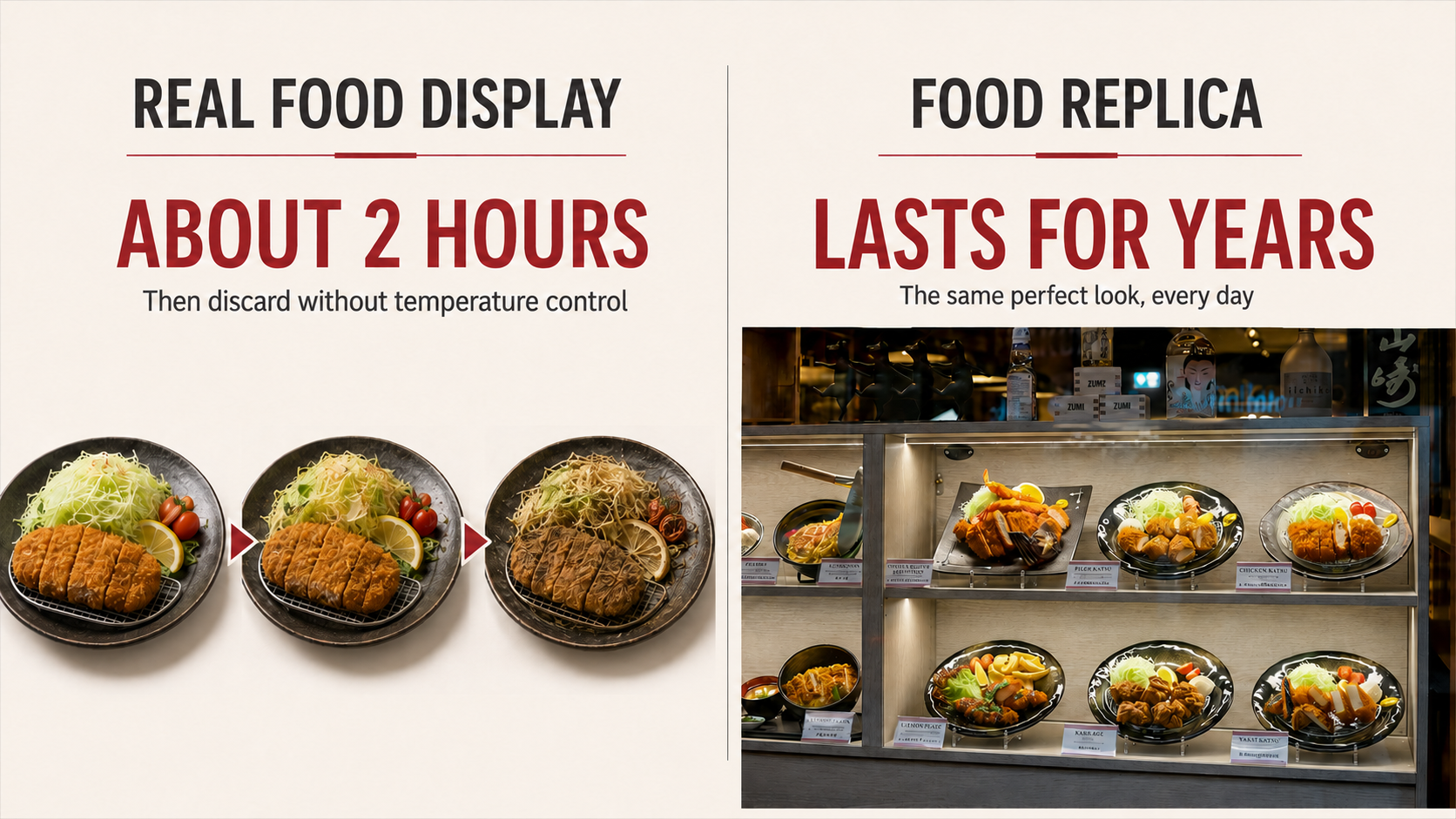
The hidden cost of putting real food on display
Real food looks free, because you already have it. On display, it is one of the most expensive things you can use, for four reasons.
It becomes unsafe fast. Under FDA and USDA guidance, food held in the danger zone of roughly 40 to 140°F should not sit out more than two hours, or one hour when it is above 90°F, because bacteria can double about every 20 minutes. A dish on display crosses that line quickly, which makes it not just unappetizing after a few hours but a health-code problem waiting for an inspector.
It looks worse by the minute. Garnishes wilt, sauces skin over, fried food goes limp, and ice cream is gone in minutes. The window you dressed at open looks tired by lunch.
It creates daily waste and labor. Real display food is re-plated and thrown away on a cycle, which is food cost and staff time spent on something no customer ever eats.
It attracts pests and odor. Open food outdoors invites exactly what you do not want near your entrance.
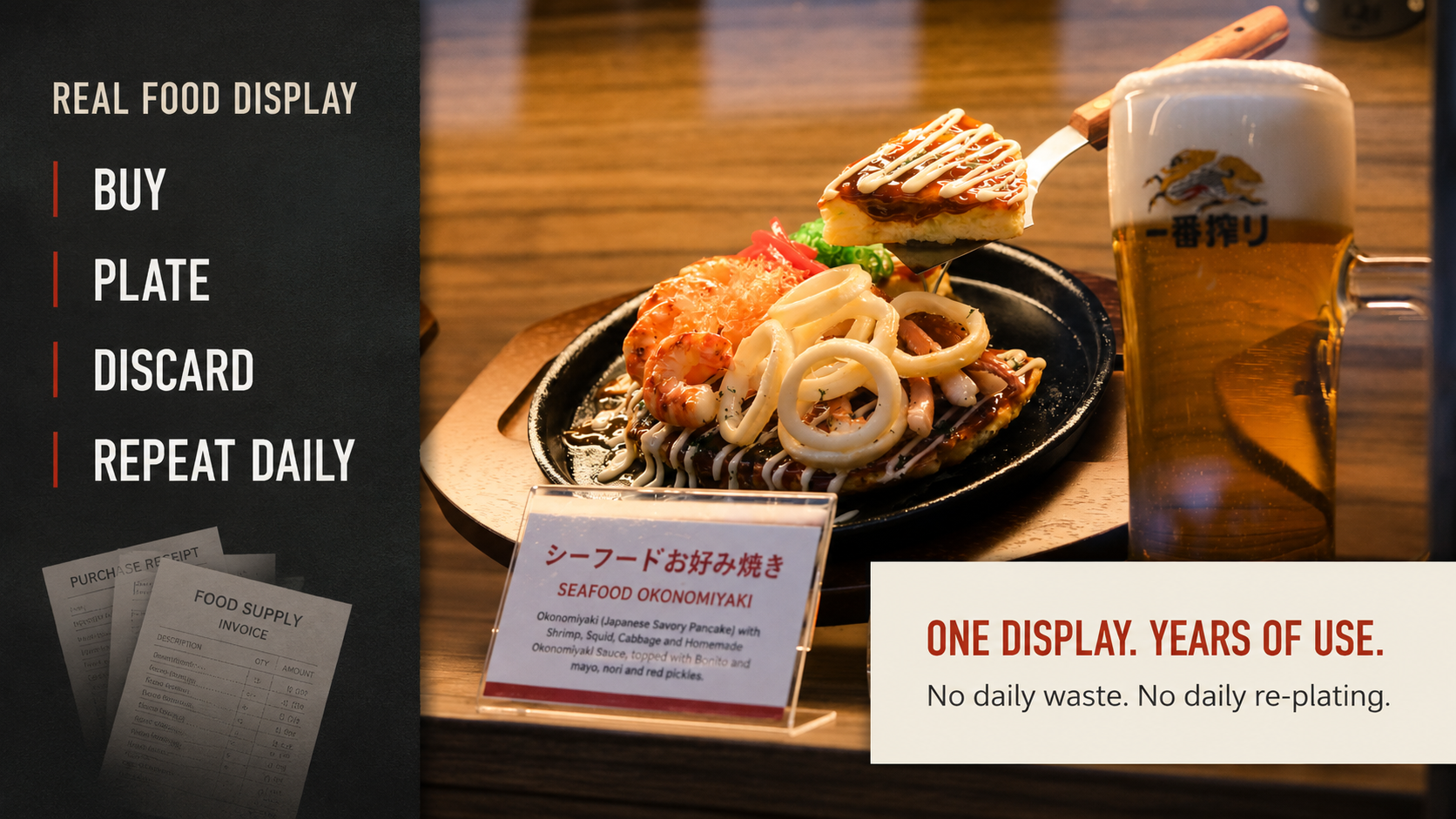
Where real food still wins
To be fair, real food is the right call in specific cases, and a replica is not a substitute for any of them:
- Anything that will be eaten: service, plated dishes, and buffet food under proper temperature control.
- Tastings and samples meant to be handed out and consumed.
- Aroma-driven marketing, like fresh bread or grilling, where the smell is the pull.
- Very short, close-up moments where a dish is prepared and consumed within the safe window.
If the food's job is to be eaten, tasted, or smelled, use real food. If its job is to be seen, a replica does it better and for years.
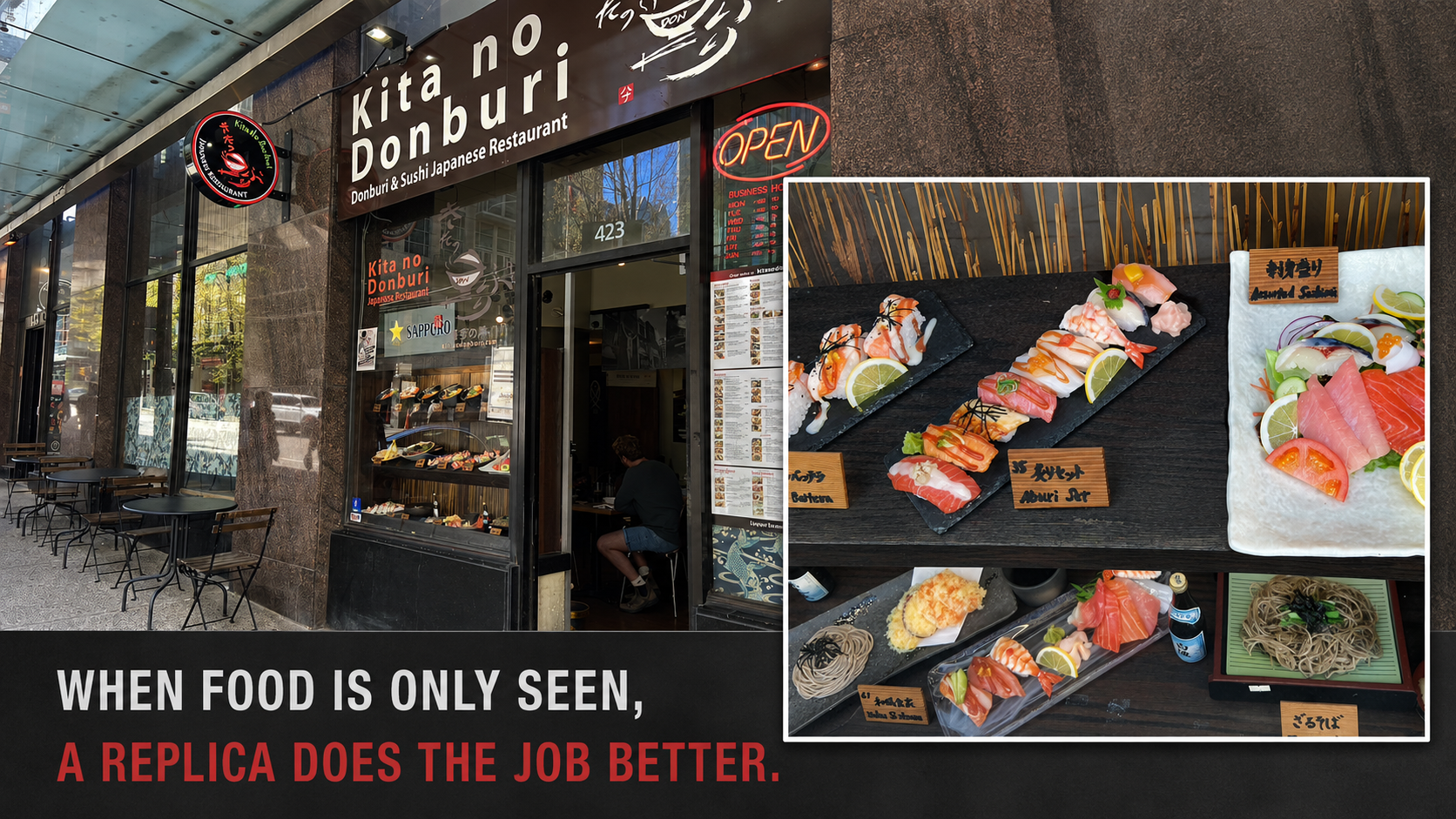
Which should you use?
Use real food when
The item will be eaten, tasted, or served within about two hours, such as active service, tastings, and samples.
Use fake food when
The item is displayed but not eaten, such as windows, counters, cases, trade shows, food trucks, and photo or film sets.
The math over time
A single plate of real display food seems cheap until you multiply it. Re-plated daily over a year, it is an ongoing food and labor cost that never converts a sale directly, because nobody eats it. A replica is bought once and shows the same dish for years. Across that life, a replica display costs a fraction of what the same dish would cost re-plated every day, and it never spoils, never violates a code, and never has to be thrown out. This is why the busiest display cultures in the world, like Japan's restaurant windows, run on replicas rather than real food. If you want the numbers for your own storefront, run them in the restaurant ROI calculator or the food truck ROI calculator.
Getting it right with CFR
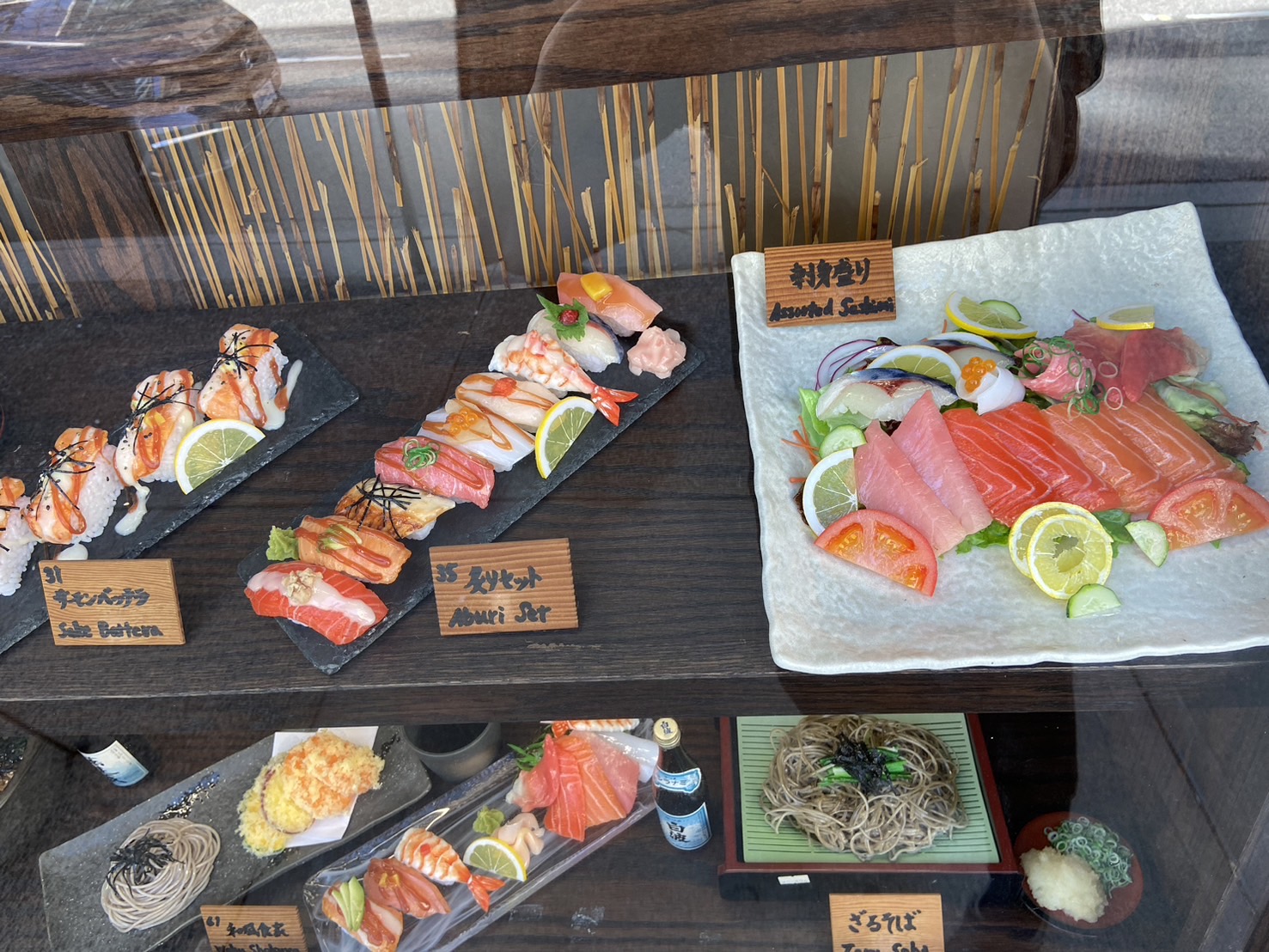
If your food's job is to be seen, the deciding factor is realism. Generic mass-produced fake food gives itself away up close, so it fails at the one thing a display has to do. A genuine shokuhin sampuru replica is hand-sculpted from your actual dish, cast in resin and silicone, and hand-painted down to the char, gloss, and portion, which is what makes a passerby stop and look twice.
Custom Food Replica builds made-to-order replicas matched to your exact dishes, made by Iwasaki, the Japanese company at the origin of the craft, and shipped nationwide. Pricing is all-in and starts at $400 per piece, with the per-piece price coming down as an order fills our shipping containers. See the display buyer's guide, the full cost breakdown, or our restaurant work.
One note on care: replicas are built for indoor display. Keep them out of direct all-day sunlight, dust them gently, and bring outdoor or food truck pieces inside after service. Most displays stay showroom-fresh for 3 to 5 years, and well-maintained pieces last 10 years or more.
The bottom line
Fake food and real food are not cheap and expensive versions of the same thing. They do different jobs. Real food is for eating. For a display that has to look perfect all day, every day, for years, without spoiling or breaking a health code, a replica is not just the better choice, it is the only one that actually works.
From $400 per piece, all-in.
Built to your exact dishes, shipped nationwide, quoted to your display.
Frequently asked questions
- Is fake food or real food better for a display?
- Fake food is better for anything shown but not eaten, because it holds its look for years without spoiling or breaking health codes, while real food becomes unsafe within about two hours.
- How long can real food sit out on display?
- Under FDA and USDA guidance, food held without temperature control should be discarded after about two hours, or one hour above 90°F, because bacteria multiply rapidly in that range.
- Is it against health codes to display real food?
- Displaying unrefrigerated food that needs temperature control is a food-safety risk and a common code issue, which is one reason replicas are used for open displays.
- Do fake food displays look real enough to replace real food?
- Yes, when they are genuine hand-sculpted replicas matched to your exact dish. Generic mass-produced pieces do not hold up at close range.
- When should I still use real food?
- Use real food whenever it will be eaten, tasted, or smelled, such as service, samples, and aroma-driven marketing.
- How long does a food replica display last?
- Most replicas stay showroom-fresh for 3 to 5 years indoors, and well-maintained pieces kept out of direct sunlight can last 10 years or more.
- How much do food replicas cost compared to real food?
- Replicas cost more upfront, starting at $400 per piece all-in, but they are a one-time purchase, while real display food is a recurring food and labor cost.
About the author
Custom Food Replica is the authorized US distributor and official partner of Iwasaki, the Japanese maker at the origin of the shokuhin sampuru food replica craft. We build hyperrealistic, made-to-order food replicas for U.S. restaurants, food trucks, and retailers, each sculpted and hand-painted to match a client's exact dishes and shipped nationwide.
Sources
- U.S. FDA, Handling Food Safely While Eating Outdoors, the 2-hour limit, and 1 hour above 90°F.
- USDA Food Safety and Inspection Service, Danger Zone (40°F to 140°F), bacterial growth and holding limits.
- FDA Food Code, section 3-501.16, time and temperature control for safety (TCS) food holding requirements. The Food Code uses 41 to 135°F, while the consumer FDA and USDA danger zone is 40 to 140°F.