
Durability & Care · Buyer's Guide
How Long Do Food Replicas Last, and How to Care for Them
By the Custom Food Replica team · Authorized US distributor & official partner of Iwasaki, Japan's original food replica makers.
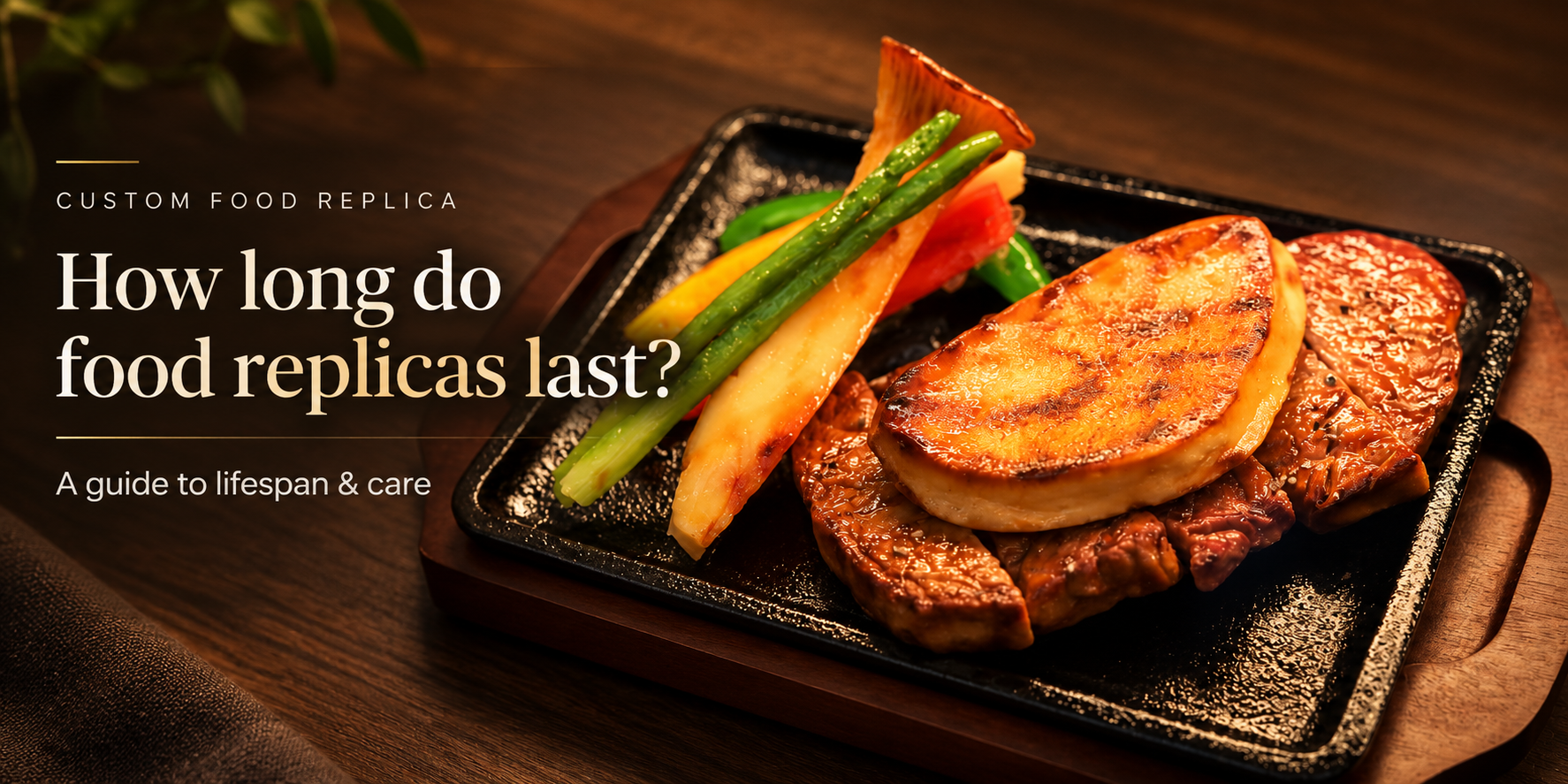
Quick answer
A quality food replica lasts 10+ years, and often much longer, with almost no maintenance. It is made from cured resin, PVC, and silicone that do not spoil, rot, or degrade in normal display conditions. The two things that shorten a replica's life are harsh, direct sunlight and high heat, both avoidable. Care is simple: a soft, damp cloth and mild soap when it needs dusting, and no abrasive cleaners.
Key facts
- Quality food replicas last 10+ years in normal display conditions with proper care.
- Food replicas do not spoil, rot, or attract pests, unlike real food.
- Direct UV sunlight and high heat are the main things that shorten a replica's life.
- Cleaning a food replica takes only a soft, damp cloth and mild soap.
How long do food replicas last?
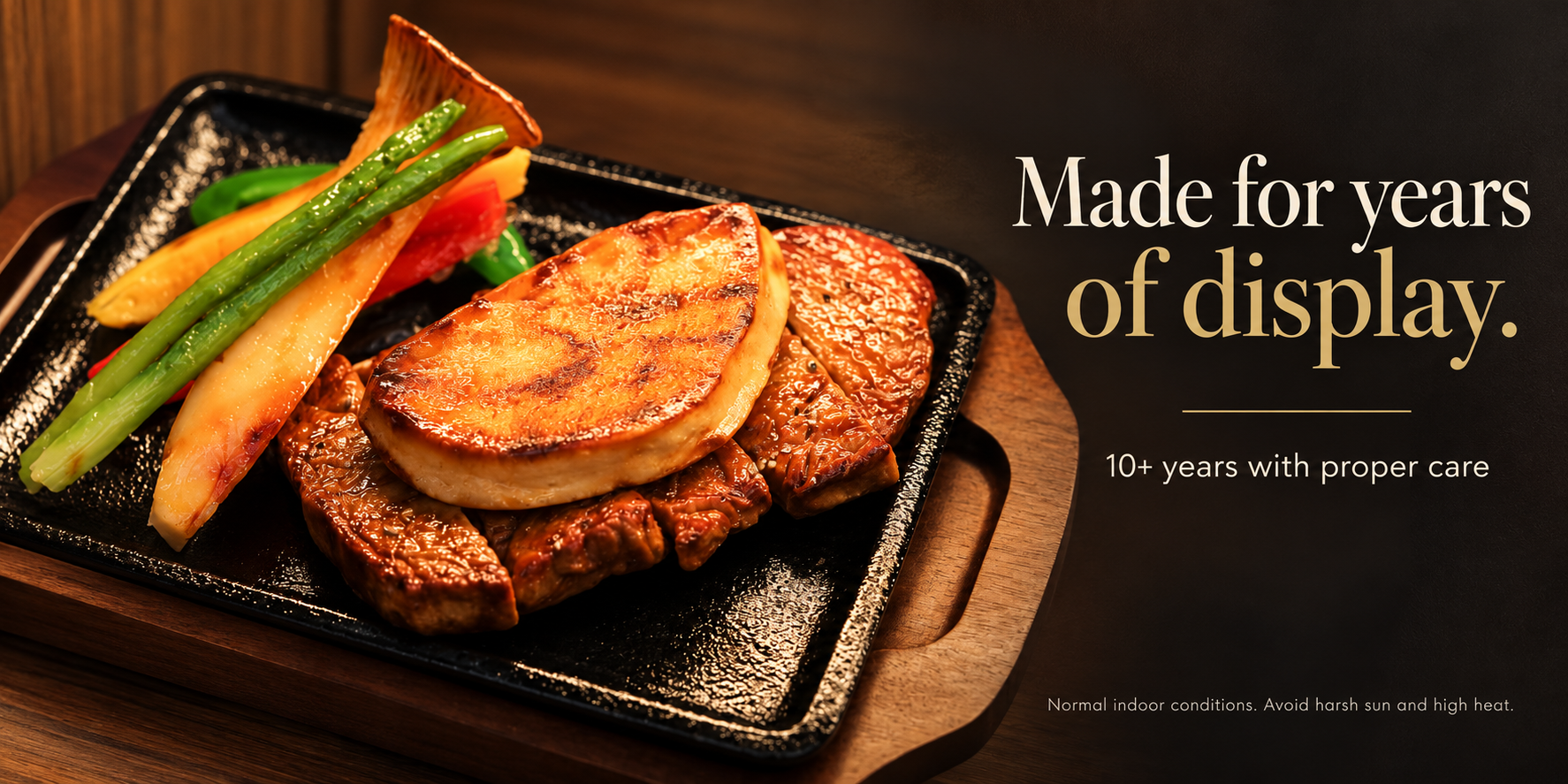
In normal indoor or window display, a quality food replica lasts well over a decade. Because it is a solid, cured object rather than organic matter, it has nothing to spoil: no moisture to grow mold, no sugars or proteins to break down, and nothing for pests to eat. Many pieces in restaurant windows have been on display far longer than ten years and still look right.
This is the core of why a replica is a good investment. Real display food is a recurring cost, re-plated and thrown out constantly. A replica is bought once and keeps working for years, which is what makes its value obvious over time. We break down the numbers in our cost guide.
What affects a replica's lifespan
A few factors decide whether a replica lasts ten years or several decades.
Sunlight (UV). This is the biggest one. Constant, direct sun can slowly fade colors over years, the same way it fades signage, upholstery, and packaging. A UV-stable finish and smart placement handle it.
Heat. Plastics soften at high temperatures, so a replica sitting against hot glass or near a heat source can warp over time. Normal room and window temperatures are fine.
Material and build quality. A well-cured, well-finished piece from a genuine maker holds up far longer than a cheap one that can yellow or grow brittle within a year. This is where quality genuinely pays off, and why where your replica is made matters. The craft itself is covered in our how food replicas are made guide.
Handling. Repeated rough handling or drops can chip fine details. In a fixed display, this rarely comes up.
How to care for food replicas
The upkeep is minimal, which is much of the appeal. A simple routine:
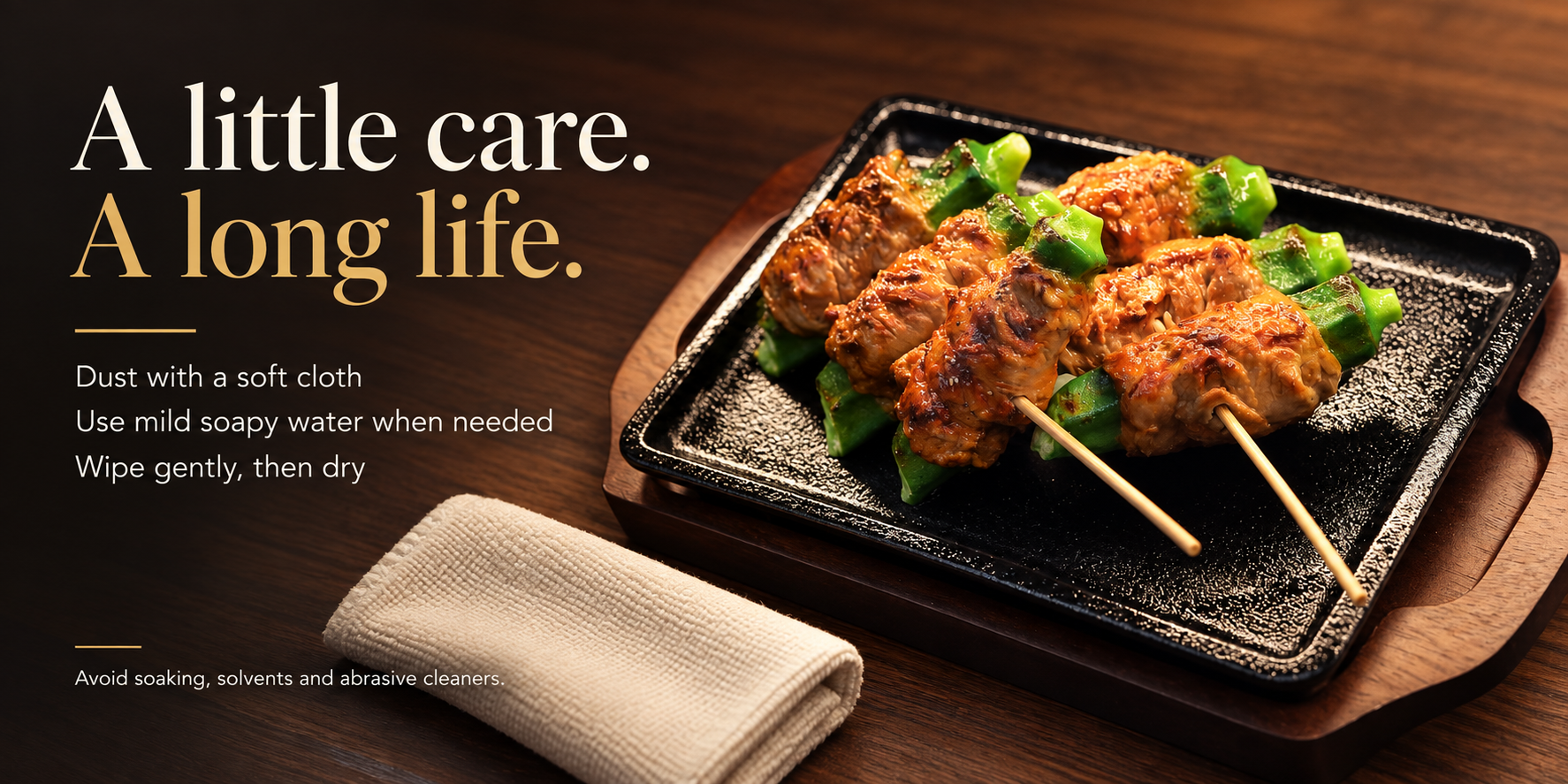
- Dust gently with a soft, dry or lightly damp microfiber cloth as needed.
- For buildup, wipe with a soft cloth and a little mild dish soap in water, then dry.
- Avoid abrasive cleaners, solvents, alcohol, and scrubbing pads, which can dull or strip hand-painted finishes.
- Do not submerge pieces with assembled components or hidden supports unless the maker says it is fine.
- Keep them away from open flame, cooking heat, and extreme temperatures.
- For sunny windows, rotate pieces occasionally so any fading is even, and ask for UV-stable finishes up front.
That is the whole job. There is no refrigeration, no replacing, and no daily re-plating. The materials themselves are covered in our guide to whether food replicas are safe and non-toxic.
Protecting a replica in a sunlit window
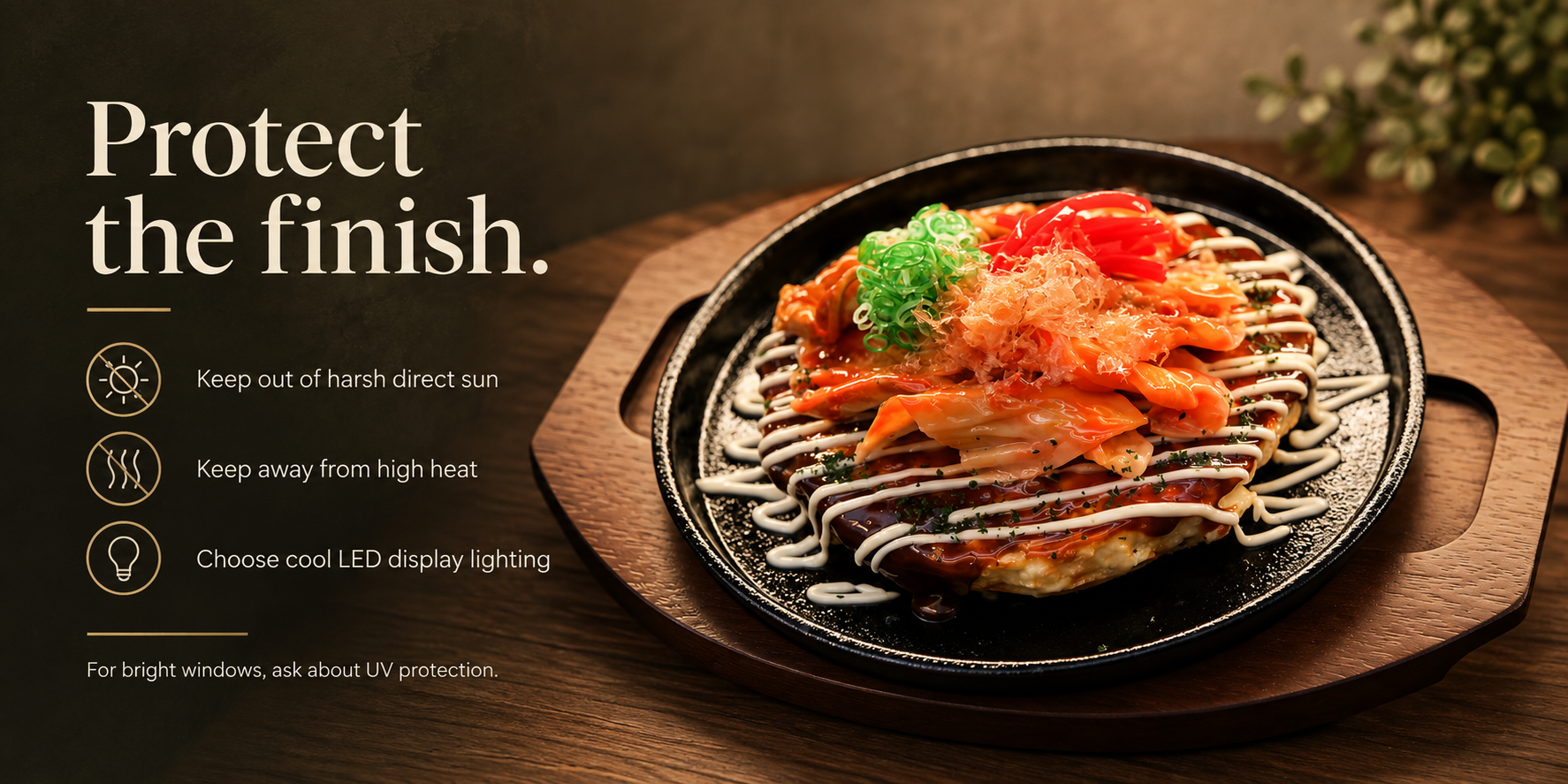
Since sun is the main enemy, a few upfront choices make the difference. Ask for UV-resistant finishes when you order, especially for a west or south-facing window. Use display lighting that runs cool, like LEDs, rather than hot halogen. And where a window gets punishing all-day sun, consider UV-filtering window film, which protects your replicas along with everything else in the space. With those steps, even a bright storefront display holds its look for many years.
When a replica finally shows its age
Even after years, a replica usually does not fail so much as slowly soften in color under sun. When that happens, a piece can often be touched up or repainted by a skilled maker rather than replaced, extending its life further. Compared with real display food, which is discarded daily, a replica's eventual, gradual aging after a decade or more is a rounding error in cost.
The bottom line
A quality food replica is one of the longest-lasting marketing tools you can buy: 10+ years, no spoilage, and care that amounts to an occasional wipe. Keep it out of harsh direct sun and high heat, clean it gently, and it will keep selling your food for far longer than almost anything else in your space.
Custom Food Replica builds made-to-order replicas by Iwasaki, the Japanese company at the origin of the craft, finished for long display life and shipped nationwide, from $400 per piece all-in. See finished work on our restaurant displays page or read the background on shokuhin sampuru.
Ready to build a display that lasts?
Send your dishes and we will quote replicas finished for long display life.
Frequently asked questions
- How long do food replicas last?
- A quality food replica lasts 10+ years in normal display conditions with proper care, because it is a cured, solid object that does not spoil, rot, or attract pests.
- Do food replicas fade over time?
- They can fade slowly under constant, direct sunlight over years, like any object exposed to UV. A UV-stable finish and smart placement prevent most of it.
- How do you clean a food replica?
- Wipe it with a soft, damp cloth and a little mild dish soap, then dry it. Avoid abrasive cleaners, solvents, and scrubbing pads that can damage the hand-painted finish.
- Do food replicas need any maintenance?
- Almost none. Occasional dusting and the rare gentle wipe are all that is needed. There is no refrigeration, replacement, or daily re-plating.
- Can food replicas be repaired or repainted?
- Often yes. A skilled maker can touch up or repaint a piece that has faded or chipped after years of use, extending its life rather than replacing it.
- Will a food replica survive in a sunny window?
- Yes, with the right finish. Ask for UV-stable finishes, use cool LED lighting, and consider UV-filtering film for punishing all-day sun.
About the author
Custom Food Replica is the authorized US distributor and official partner of Iwasaki, the Japanese maker at the origin of the shokuhin sampuru food replica craft. We build hyperrealistic, made-to-order food replicas for U.S. restaurants, food trucks, and retailers, each sculpted and hand-painted to match a client's exact dishes, finished for long display life, and shipped nationwide.
Sources
- Toxic-Free Future: how PVC formulations behave with heat and age.
- U.S. EPA: UV radiation and why sustained exposure degrades materials over time.
- Canadian Conservation Institute: long-term stability of plastics and recommended handling and cleaning.