
Dessert shops · Visual menu guide
The Crepe Wall Effect: How Dessert Stands Sell With a Wall of Fake Food
By the Custom Food Replica team, authorized US distributor and official partner of Iwasaki, Japan's original food replica makers.
Quick answer
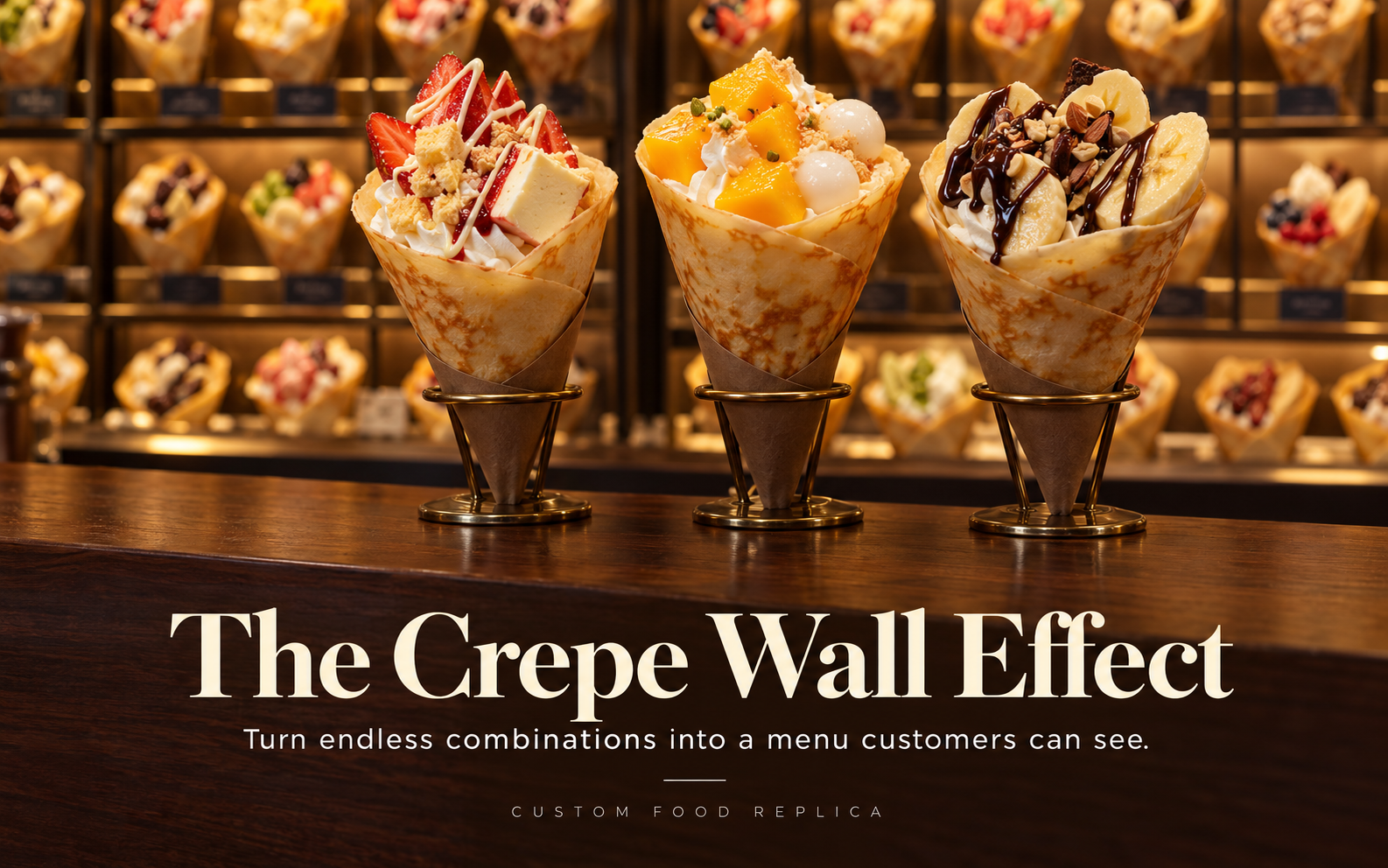
A crepe, waffle, or made-to-order dessert stand often offers so many combinations of base, filling, and topping that no menu board can represent them all, and no kitchen can keep them all made and fresh at once. The fix used by the best-known stands, most famously in Tokyo's Harajuku district, is a full wall of handcrafted food replicas showing every option at once, so customers point at what they want instead of trying to imagine it. Unlike real whipped cream, fresh fruit, and warm crepe batter, which start collapsing within the hour, a replica wall keeps looking right for years with proper indoor care.
Key facts
- Made-to-order dessert stands often have far more combinations than they can display fresh at once.
- Real toppings like whipped cream, fresh fruit, and ice cream begin to collapse, brown, or melt within an hour of being plated.
- A full replica wall lets customers choose visually instead of reading a long combination-based menu.
- Custom Food Replica is the authorized US distributor and official partner of Iwasaki, the origin of the food replica craft.
The problem only made-to-order dessert shops have
A taco truck has a menu of maybe ten fixed items. A crepe stand has a menu that's really a set of building blocks: a handful of bases, a dozen fillings, a wall of toppings, and any customer can combine them however they like. Multiply that out and a modest crepe menu can represent dozens or even hundreds of possible finished desserts. A printed menu can list the components, but it can't show what a strawberry cheesecake crepe with white chocolate drizzle actually looks like next to a mango mochi one.
This is a different problem from a restaurant with a fixed menu. It isn't decision fatigue from too much text. The entire product is built from combinations, and only a small number of them can physically exist as real food at any given moment.
Why you can't just make extra and put them out
The instinct might be to plate a few extra crepes and keep them on the counter as examples. In practice, that fails almost immediately. Whipped cream loses its shape and starts weeping liquid within about an hour at room temperature. Fresh fruit browns and dries out. A crepe itself goes from soft and appealing to stiff and unappetizing well before the lunch rush ends. Ice cream, if it's part of the build, is gone in minutes.
A real-food display would need to be replated constantly, wasting ingredients and staff time on desserts nobody eats, and it would still look tired between refreshes. For a deeper comparison, see fake food vs real food for display.
The solution: a full wall, not a single sample
The stands that have solved this most visibly are the elaborate crepe and dessert storefronts in dense shopping districts, most iconically Tokyo's Harajuku neighborhood. There, a wall of individually lit crepe replicas, dozens of finished combinations each labeled with a name and price, fills the entire storefront window. Shelf after shelf of glossy crepes that never change, never melt, and never run out. It's one of the clearest real-world examples of what a food replica wall can do at scale, and it's worth understanding even if your own display ends up much smaller.

The effect works because it solves the combination problem and the selling problem at the same time. A customer walks the length of the wall, sees exactly what “strawberry cheesecake” or “mango mochi” looks like, and orders with confidence in under a minute, no menu-reading required. This is the same idea behind the traditional shokuhin sampuru window.
Where this applies beyond crepes
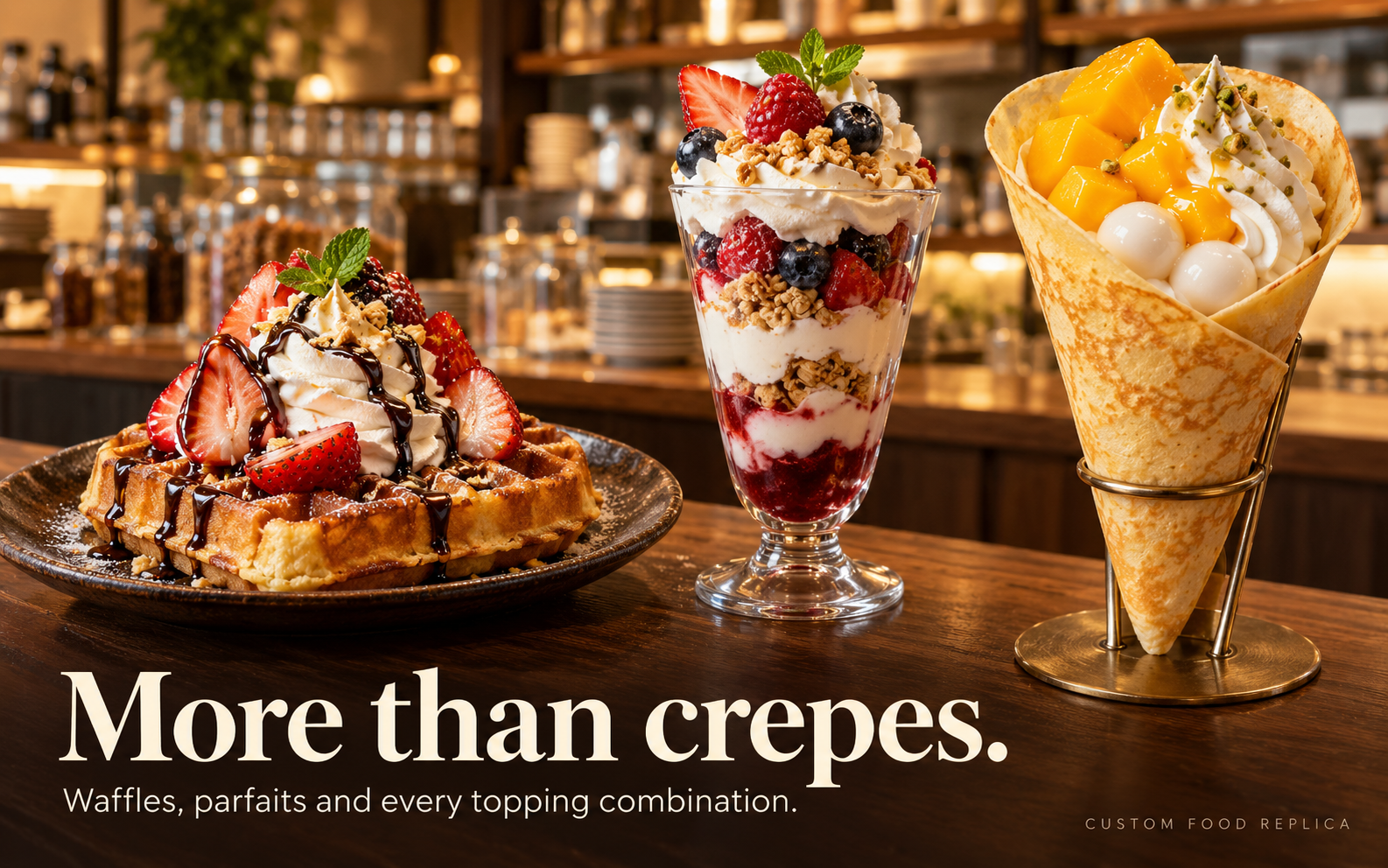
The same mechanism shows up anywhere a dessert is built to order from a large set of options: waffle and pancake bars with a topping station, loaded shaved ice stands, parfait or yogurt bowl counters, and donut shops with a wall of glaze and topping combinations. Wherever the finished product is really a combination of choices rather than a single fixed item, a wall of replicas does the same job: it turns an abstract menu of parts into a concrete wall of finished results.
Custom replicas versus generic fake dessert props: know the difference
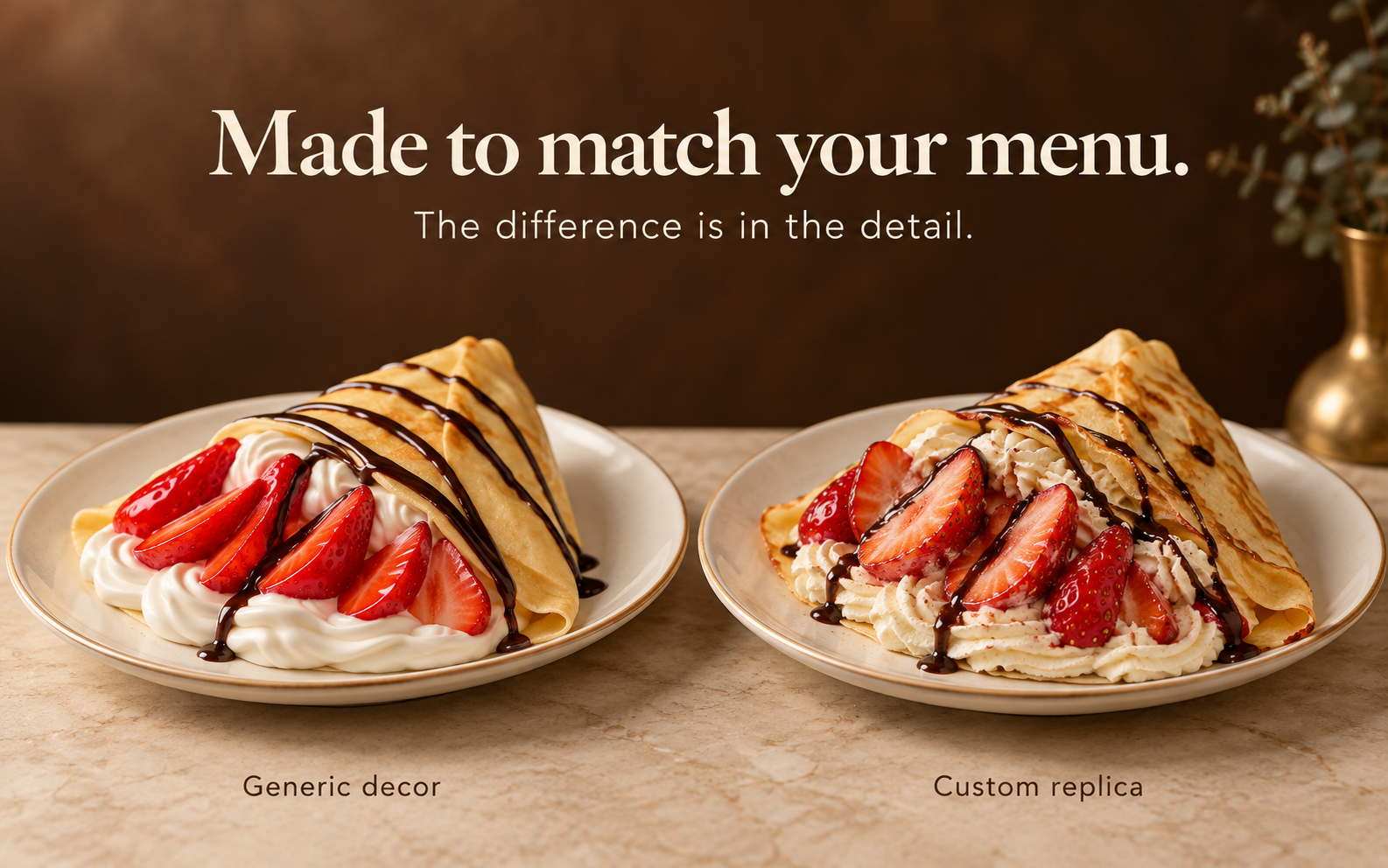
Search for “fake dessert” or “fake pastry decor” online and you'll mostly find generic foam or resin props: identical donuts, cupcakes, or pastries sold in bulk sets for photo backdrops, party decoration, or bakery case filler. They're mass-produced from one mold and painted the same simple way every time, which is why a shelf of them looks repetitive and slightly off up close: the icing too smooth, the fruit too uniform, the colors a shade too bright.
That's the opposite of what a combination wall needs. The selling point of a crepe wall is that each piece looks like a specific, real, appealingly imperfect dessert someone could order right now, with fruit placed the way your server places it and cream piped the way your recipe pipes it. A genuine custom replica is hand-sculpted and hand-painted to match your actual toppings, portions, and presentation. Our custom vs stock guide explains where each type belongs.
Planning a wall, not a single piece
Because a combination wall represents your whole menu at once, plan it as a system rather than an afterthought purchase, the same way a full window display deserves early planning during buildout. If you're opening new, see our restaurant launch guide.
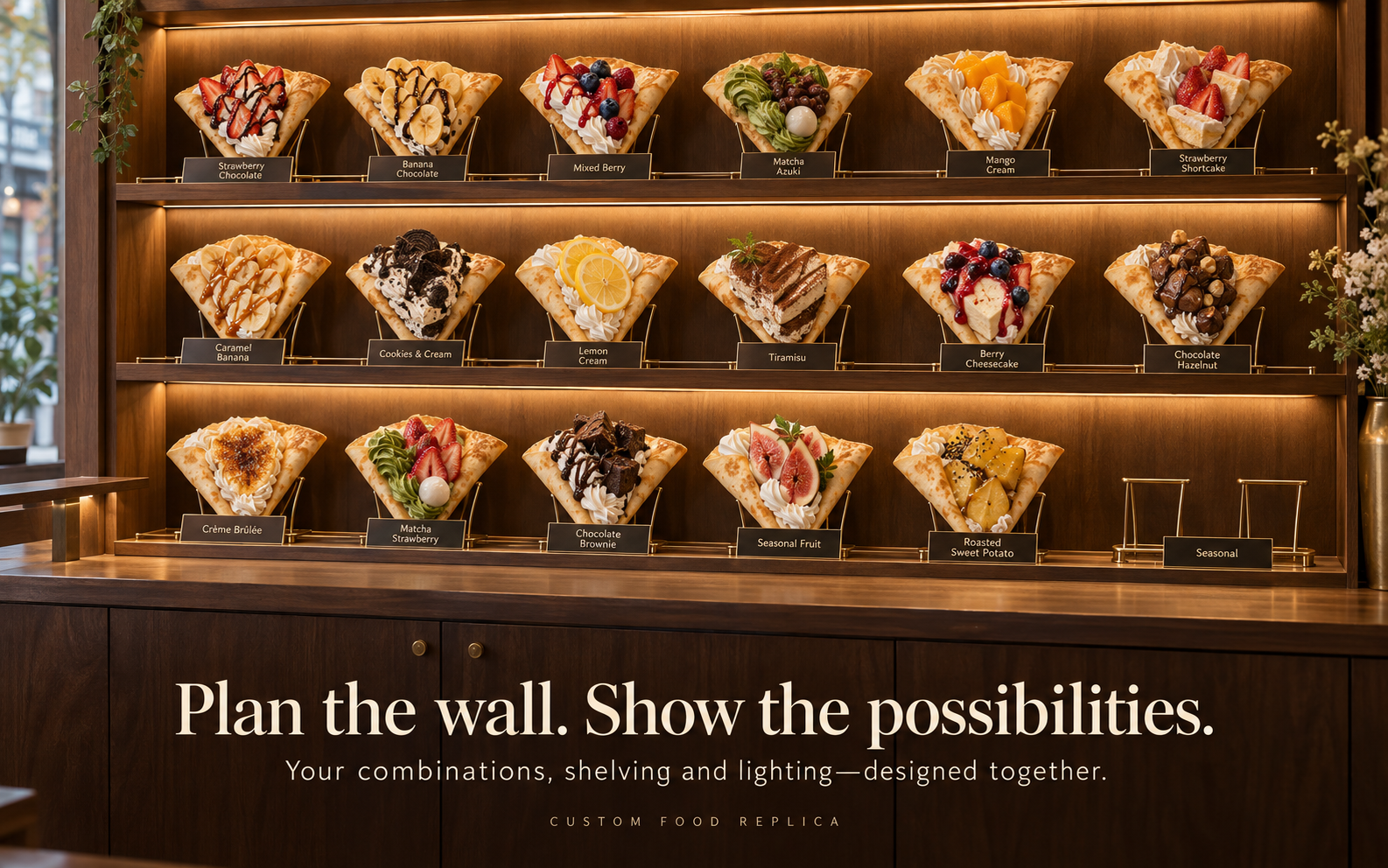
- Map your actual combinations first. List your bases, most popular fillings, and most popular toppings, then pick the combinations that best represent your range. Most walls show 15 to 40 finished pieces, enough for real variety without visual noise.
- Prioritize best sellers and distinctive builds. A plain chocolate crepe and a loaded rainbow one both deserve a spot, since the wall should show both safe and familiar and impressive and shareable.
- Plan shelving and lighting as one system. Individually lit tiers, angled slightly forward, let each piece read clearly on its own. Use cool LED lighting and avoid prolonged direct sun.
- Label clearly. Since the wall is your menu, each piece needs a small, legible label with its name and price.
- Leave room to grow. A seasonal special is easiest to add if the wall was built with spare shelf capacity from the start.
How CFR builds a combination wall
The process starts the same way any custom replica does: we need to see and understand your actual toppings and presentation in detail. For most items, that means clear, well-lit photos of the finished dessert from a few angles, plus notes on portion size, the exact fruit or garnish you use, and how it's plated.
One honest note specific to this category: Iwasaki's process for the most precise color and texture match generally relies on a physical sample sent to our Osaka location. A finished dessert built from whipped cream and fresh fruit is a harder item to ship intact than a dry or shelf-stable food, so sample logistics for cream and fruit topped items are something we'll work through with you directly at the quote stage, rather than something we can promise is simple for every recipe. Detailed photos and specifications get us most of the way there in every case, and we'll tell you plainly if your build needs a different approach.
From there, each piece is hand-sculpted and hand-painted individually, which matters more here than almost anywhere else: a wall of forty replicas only works if each one looks like its own dessert, not a copy of its neighbor. See how food replicas are made for the full process.
What it costs
A combination wall is priced like any custom order: per piece, based on complexity, with the price per piece coming down as the order grows. Custom replicas start at $400 per piece, all-in, including shipping and customs. A wall showing 15 to 40 combinations is a larger order than a typical restaurant window, so talk to us early about your target count and we'll help you sequence it, sometimes starting with a core set and expanding over time. See the full cost breakdown or get a quote.
The bottom line
A made-to-order dessert menu is genuinely hard to sell with words or a few real samples, because the whole point is combination and choice. A full wall of handcrafted replicas solves that by showing every option at once, the way the most memorable crepe and dessert stands already do. It turns your menu from something a customer has to imagine into something they can simply point at.
Plan your dessert wall
Send your combinations, target piece count, and space for a custom quote.
Frequently asked questions
- Why do crepe shops use fake food displays instead of real crepes?
- Real whipped cream, fresh fruit, and crepe batter start losing their shape, browning, or drying out within about an hour, so a real-food display would need constant replating. A replica wall shows the same combinations permanently with no upkeep.
- How many pieces does a typical dessert wall need?
- Most walls show 15 to 40 finished combinations, enough to demonstrate real menu variety without crowding the display. You don't need every possible combination, just your best sellers and most distinctive builds.
- Can you match my exact toppings and presentation?
- Yes. Each piece is hand-sculpted and hand-painted from your specific recipe, using detailed photos and notes, and a physical sample where that's feasible for the item.
- Does this work for anything besides crepes?
- Yes. The same combination-menu problem applies to waffle and pancake bars, loaded shaved ice, parfait counters, and donut shops with a topping wall.
- How is this different from the fake pastries sold online?
- Generic fake dessert props are mass-produced from one mold and look repetitive up close. A custom replica is hand-finished to match your specific toppings and portions, which is what makes a whole wall look like a real menu rather than decor.
- How much does a dessert wall cost?
- Custom replicas start at $400 per piece all-in, including shipping and customs, with the per-piece price decreasing at higher quantities. A full wall is quoted based on how many combinations you want to show.
About the author
Custom Food Replica is the authorized US distributor and official partner of Iwasaki, the Japanese maker at the origin of the shokuhin sampuru food replica craft. We build hyperrealistic, made to order food replicas for US restaurants, dessert stands, and retailers, each sculpted and hand-painted to match a client's exact recipe and shipped nationwide.
Sources
- USDA FSIS, the Danger Zone: guidance on perishable foods such as dairy left at room temperature.
- Custom vs stock fake food: quality differences between mass-produced decorative props and custom handcrafted replicas.