
Ice cream and gelato · Visual menus
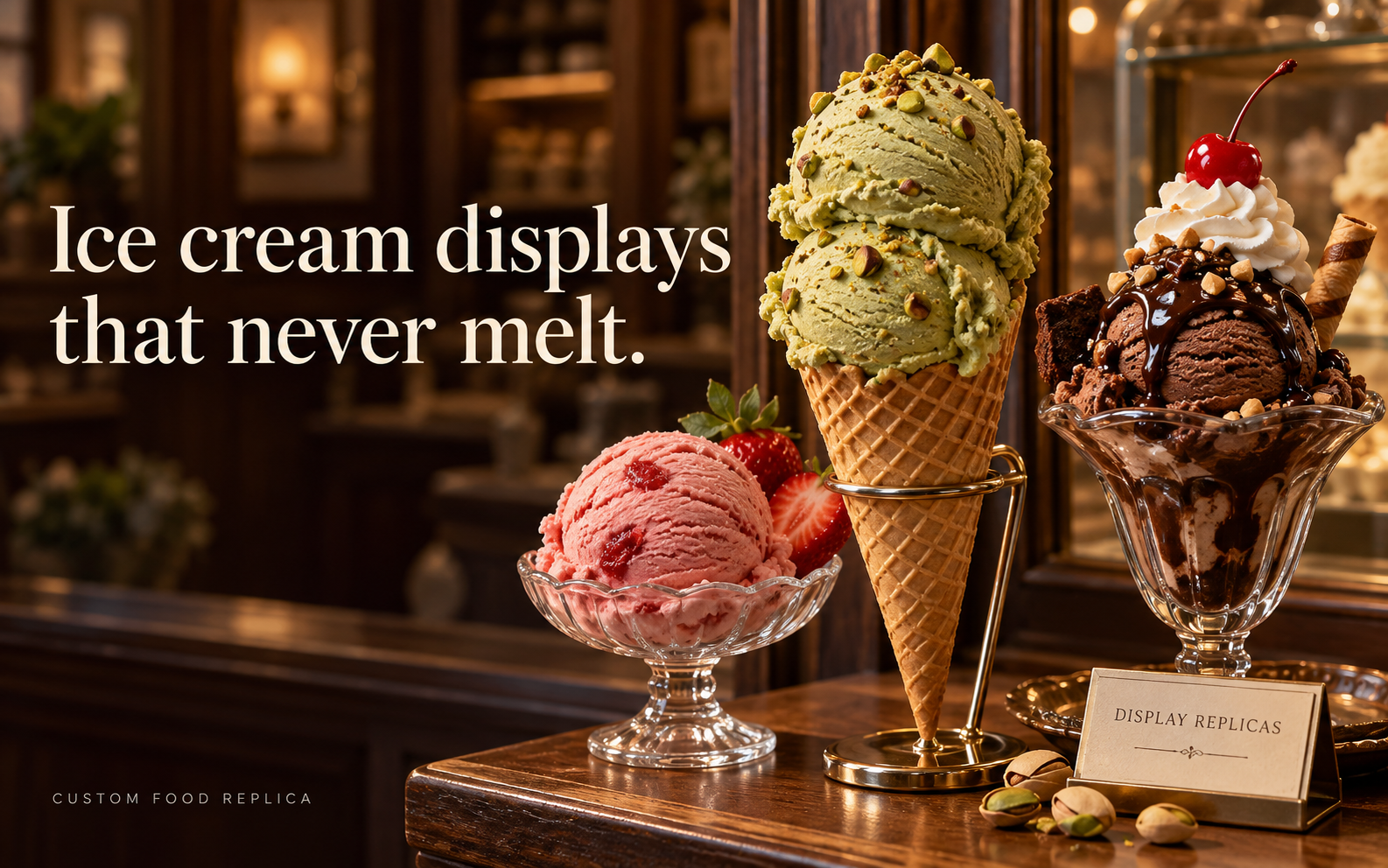
Ice cream displays that never melt: how gelato shops use replicas
By the Custom Food Replica team · Last updated · 7 min read
Custom Food Replica is the authorized US distributor and official partner of Iwasaki, the Japanese company that popularized food replicas.
Key facts
- GoFoodservice cites the International Dairy Foods Association's easy dipping range for ice cream as about 6 to 10°F.
- Published gelato serving and cabinet guidance varies, roughly 7 to 22°F depending on the recipe and cabinet.
- Both are far colder than a shop window, so real scoops cannot hold their shape there.
- A replica doesn't melt, drip, or need a freezer, and can be made to match your actual flavors.
Your best display is stuck inside the freezer
A dipping cabinet is a good way to sell ice cream. Customers see the flavors, staff scoop fast, and the product stays at the right temperature. But it only works on people already at the counter, looking down through the glass. From the sidewalk, a passerby sees a sign and not much else. They can't see the pistachio, the salted caramel, or the sundae with hot fudge, because none of it can go in the window.
Most food businesses solve this by putting the food where people can see it. Ice cream shops can't, so the items most likely to pull someone in are the ones they can't show.
Why real ice cream can't sit out
GoFoodservice's gelato cabinet guide gives about 6 to 10°F for easy ice cream dipping. Gelato runs warmer. Foodservice Equipment Reports lists 10 to 22°F for gelato displays, while Wikipedia gives a serving range of about 7 to 12°F. These are different guides, not a universal setting for every recipe. Either way, it's well below room temperature, let alone the temperature of a sunny window.
Even inside the cabinet there's not much margin. Cabinet monitoring provider Temp Assure describes how a warm gelato case can let the product soften and lose its structure. Take a scoop out of that environment and it starts melting. Shops that want something in the glass often end up with a printed photo or nothing.
What a replica does that the case can't
A replica doesn't replace the cabinet. Customers still buy real scoops. It takes over the displays that real ice cream can't do.
A flavor lineup facing the street
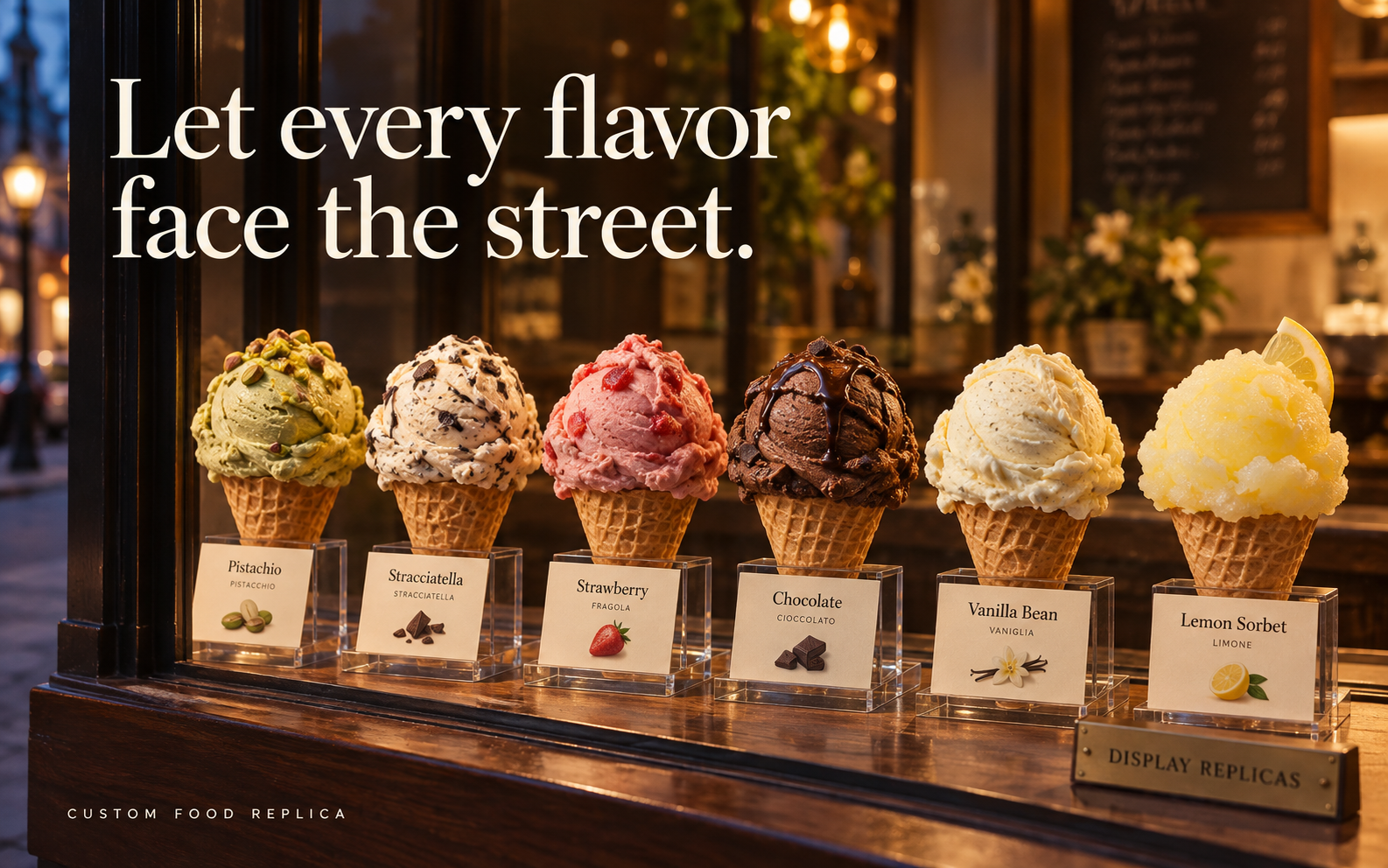
A row of scoops on small pedestals, in the window or on the counter, each with a flavor card. People see the color and mix-ins from outside: the green of pistachio with nut pieces, the dark flecks in stracciatella, the fudge ribbon through the chocolate. A passerby can pick a flavor before opening the door, rather than walking in just to read a board.
Finished builds
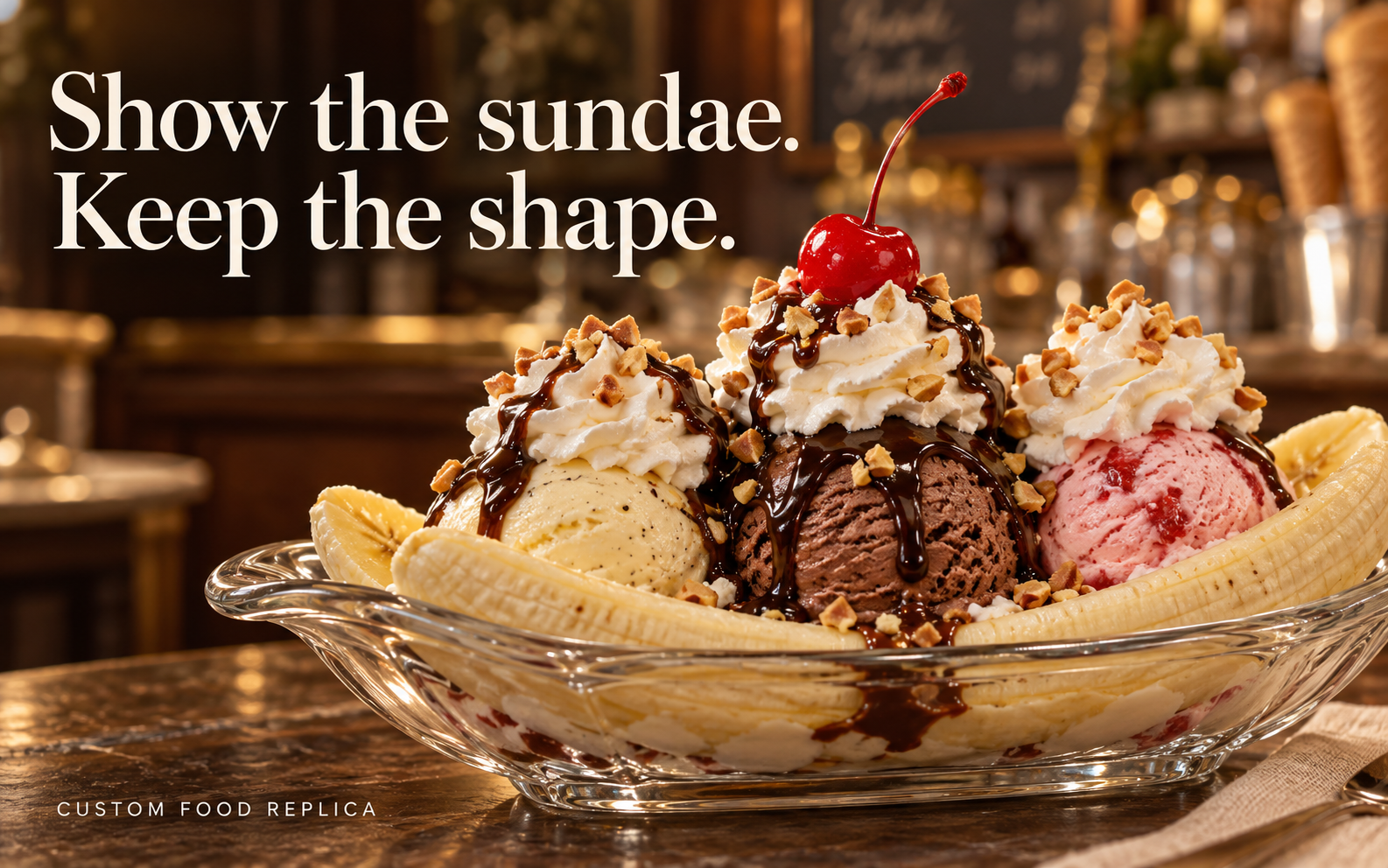
The sundae, the banana split, the milkshake with whipped cream, the cone dipped in chocolate and rolled in sprinkles. These can be some of the higher priced items on a menu and the hardest to show, since they're assembled to order and start to slump once finished. A replica holds one at its best, with the sauce where it looks good and the cream standing up.
Seasonal and limited flavors
When the pumpkin flavor launches, its replica can go in the window that week and come down when the flavor does. Unlike a poster, a three dimensional display shows the texture and portion. Keep a piece for the next season if the recipe and presentation stay the same.
Carts, stands, and pop-ups
Outdoor stands and trucks often have a small service window and no glass case. A lineup on the counter shows the menu without exposing real product to sun and heat. Replicas are not designed for extended outdoor use: protect them from weather and direct sun, and bring them indoors after service.
What replicas don't replace
Keep the real scoops in the cabinet. Replicas are display objects, not edible products, and tasting spoons and samples are still real. Use a clearly visible display sample label wherever a customer might mistake a replica for food for sale, alongside a flavor name and price. We cover placement in our restaurant window display ideas.
Custom replicas versus the fake ice cream you find online
Search for fake ice cream or a fake sundae on Amazon and other online marketplaces and you'll find foam or resin props for decor, photo shoots, and play kitchens. Generic sets aren't made to represent any particular shop's flavors. They can serve as decorations, but don't necessarily show customers what you sell.
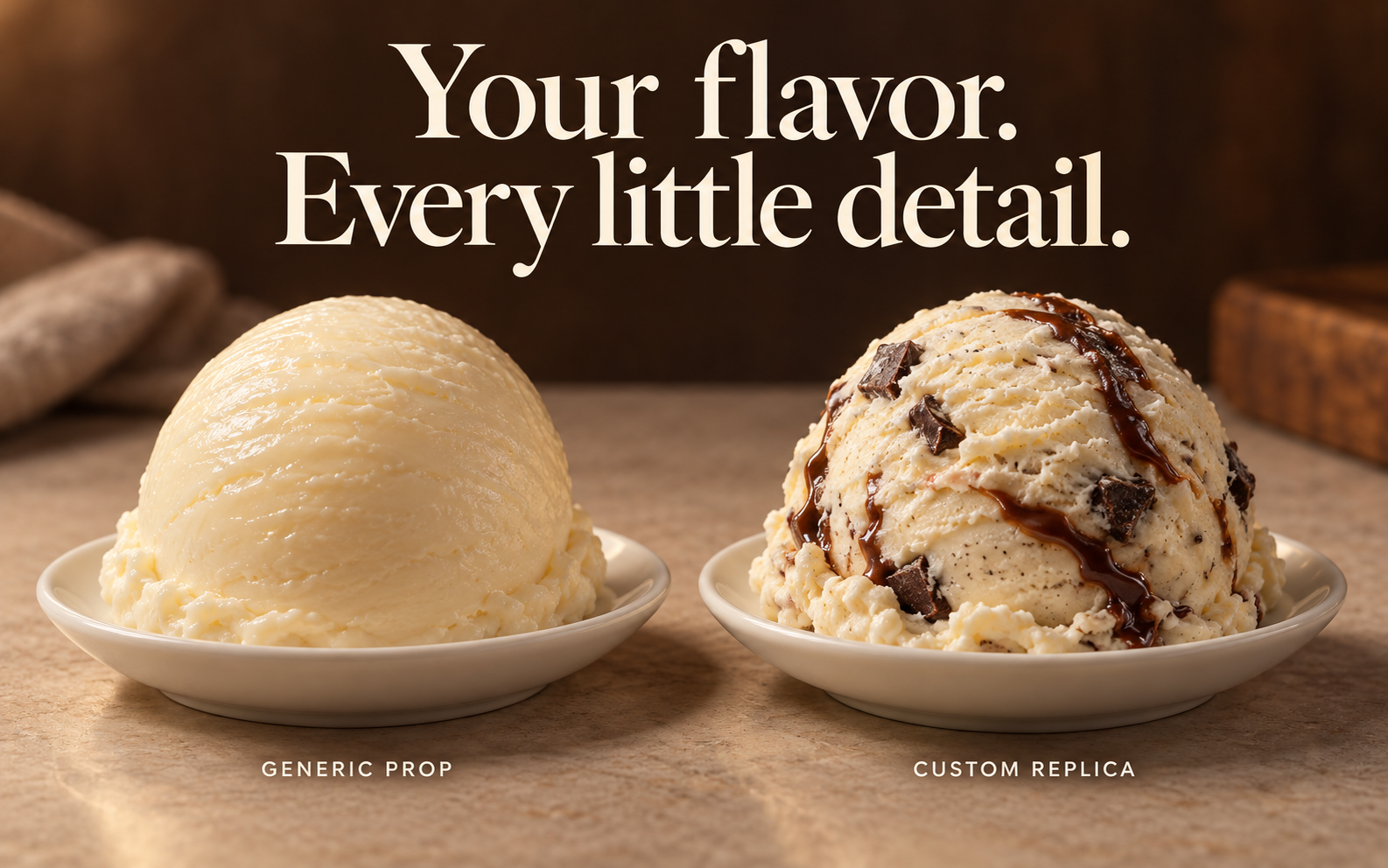
Ice cream is hard to fake well. A real scoop has a slightly dry, matte surface with fine ridges, small texture changes, and mix-ins at odd angles. Sauces are glossy, cream is soft and matte, and cookie pieces are dull and crumbly. A uniformly shiny prop can miss those differences.
A custom replica is made to represent your product. The pistachio has your pistachio's color and the right size of nut pieces. The fudge ribbon is as thick as yours. The cone has the pattern of your cone. That's what lets a lineup read as a menu rather than decoration. More in custom vs stock fake food and the shokuhin sampuru craft guide.
How we make your flavors
Start with photos of each flavor, scooped and plated the way you serve it, from a few angles, plus notes on chunk size, swirl colors, nuts, sauces, and the cone or cup. Ice cream can't make the trip to Japan intact, so don't arrange sample shipping before discussing the item with us.
We confirm the production approach and any specimen requirements with Iwasaki at the quote stage. Whether a suitable specimen can be recreated in Japan needs to be agreed for your particular item, not assumed. Photos and notes start that conversation; they aren't a promise that every item can be molded without a specimen.
If you can provide the exact glass or dish, discuss sending it to our Osaka location. If you can't, we can source a similar item based on your requirements, but it won't be the exact item. Iwasaki's artisans mold and hand-paint the pieces using the process described in how food replicas are made.
Planning the display
Four to eight pieces is a useful starting plan for a modest window, not a requirement. Pick signature flavors and a best selling build, then check the spacing and visibility from the sidewalk. Place them where people can comfortably see them and add a flavor card to every piece.
Try warm LED light around 2700 to 3000K and check that it represents your flavors accurately. Avoid heat producing lamps and prolonged direct sun. Typical indoor lifespan is 3 to 5 years; some pieces last 10 years or more depending on maintenance, not a guarantee. See our care guide.
What it costs
Custom replicas start at $400 per piece, all-in, with shipping and customs included. Final pricing depends on complexity and quantity, and no piece is quoted below that floor. Each scoop or sundae is its own piece, so six flavors and two sundaes is eight pieces.
Most shops start with signature flavors and a best selling build, then add more later. The full cost breakdown has the details.
If you're opening a shop or refreshing a window, send your flavor list and photos for a quote and we'll tell you what a display would take.
Frequently asked questions
- Can you make replicas of my actual flavors?
- Each custom piece is handcrafted to match your flavors, mix-ins, and presentation, with the production approach confirmed from your photos and notes at the quote stage.
- Why can't I just put real scoops in the window?
- Ice cream and gelato need temperatures well below freezing to hold their shape, so outside the cabinet they start to melt.
- Do the replicas replace my freezer case?
- No, the case stays because that's where you sell real product, and replicas handle window, counter, and finished sundae displays.
- Do I need to send a sample?
- Start with photos and notes rather than shipping melting ice cream to Osaka; we confirm any specimen requirements and feasible production options for each item at the quote stage.
- How is this different from the fake ice cream sold online?
- Generic props are decorations, while a custom replica is made to represent your own flavors, portions, and presentation.
- How much does it cost?
- Custom replicas start at $400 per piece all-in, including shipping and customs, and each scoop or sundae counts as one piece.
About the author
Custom Food Replica is the authorized US distributor and official partner of Iwasaki, the Japanese maker at the origin of the shokuhin sampuru food replica craft. We coordinate custom food replicas for restaurants, dessert shops, and retailers in the US, built to match each client's dishes and shipped nationwide.
Sources
- GoFoodservice, ice cream freezer guide: cites the IDFA dipping range of 6 to 10°F.
- GoFoodservice, gelato dipping cabinets: easy dipping guidance for ice cream.
- Foodservice Equipment Reports, Showing Off Gelato: gelato display range of 10 to 22°F.
- Temp Assure, gelato cabinet temperature: temperature drift and product structure.
- Wikipedia, Gelato: general serving temperature context.