
Bakeries · Waste and ROI
How Bakeries Can Stop Throwing Away Pastries Used Only for Display
By the Custom Food Replica team, authorized US distributor and official partner of Iwasaki, Japan's original food replica makers.
Quick answer
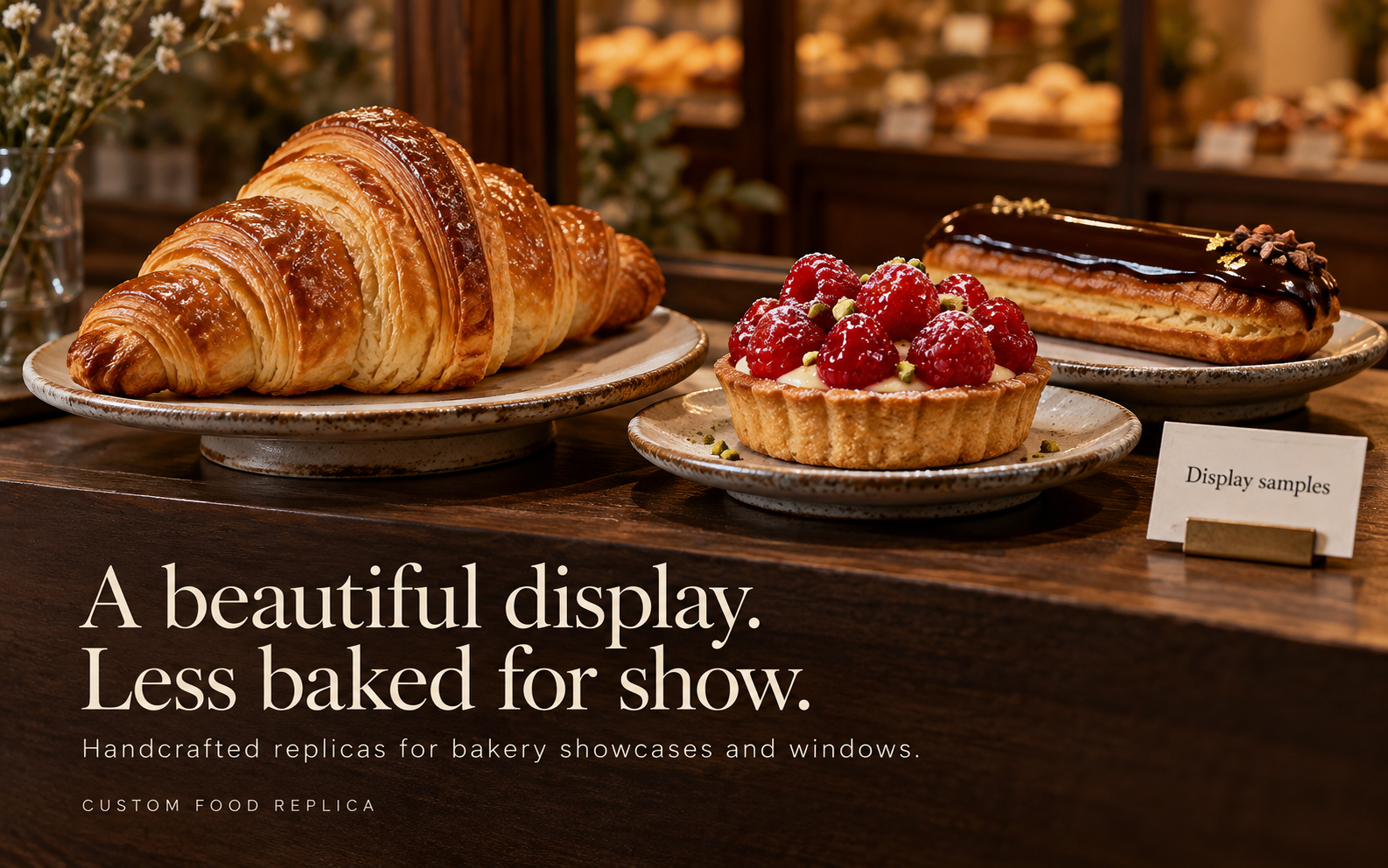
A meaningful share of what a bakery bakes every day is never sold. Industry data puts unsold bread and bakery items at roughly 10 to 13% of what's produced, and some estimates put bakery items among the highest waste categories in retail. Some of that waste comes specifically from baking extra just to keep a case looking full. Handcrafted food replicas fix the part of this problem that's about appearance rather than appetite: showcase pieces, consultation samples, and visual padding that was never meant to be eaten in the first place.
Key facts
- Industry data (ReFED, 2025) puts unsold bread and bakery items at roughly 10 to 13% of production, one of the highest unsold rates of any retail food category.
- A separate industry estimate (Pacific Coast Food Waste Commitment) puts bakery items at about 15.8% of all unsold retail food in the US.
- Overstocking specifically to make a display look full is a documented driver of retail food waste.
- Custom Food Replica is the authorized US distributor and official partner of Iwasaki, the origin of the food replica craft.
The part of bakery waste nobody talks about
Bakeries have one of the worst food waste rates in retail, and it isn't close. A 2025 industry report from ReFED, a nonprofit that tracks food waste across major US retailers, found that breads and bakery items go unsold at a rate of roughly 10% by volume and nearly 13% by value, among the highest of any department tracked, well above categories like dairy or dry goods. A separate industry estimate from the Pacific Coast Food Waste Commitment puts bakery items at around 15.8% of all unsold food in American retail.
Some of that is simple overproduction and short shelf life, which is a real and separate problem. But a specific, avoidable slice comes from something else: baking extra, or keeping pieces on display, purely to make a case look appealing. Retail research on display merchandising has found that overstocking to create a sense of abundance is itself a measurable driver of waste in fresh departments. A half-empty pastry case looks like a bakery that's closing for the day, so the instinct is to keep it visually full, and visually full often means baking more than demand calls for.
That's the part of the waste problem a food replica can solve directly, without changing a single thing about what customers actually buy.
Three ways replicas fix this, without touching your actual inventory
This is not a pitch to replace your working case with fakes customers can't buy. It's narrower and more useful than that.
1. Showcase and consultation pieces that were never going to be sold anyway
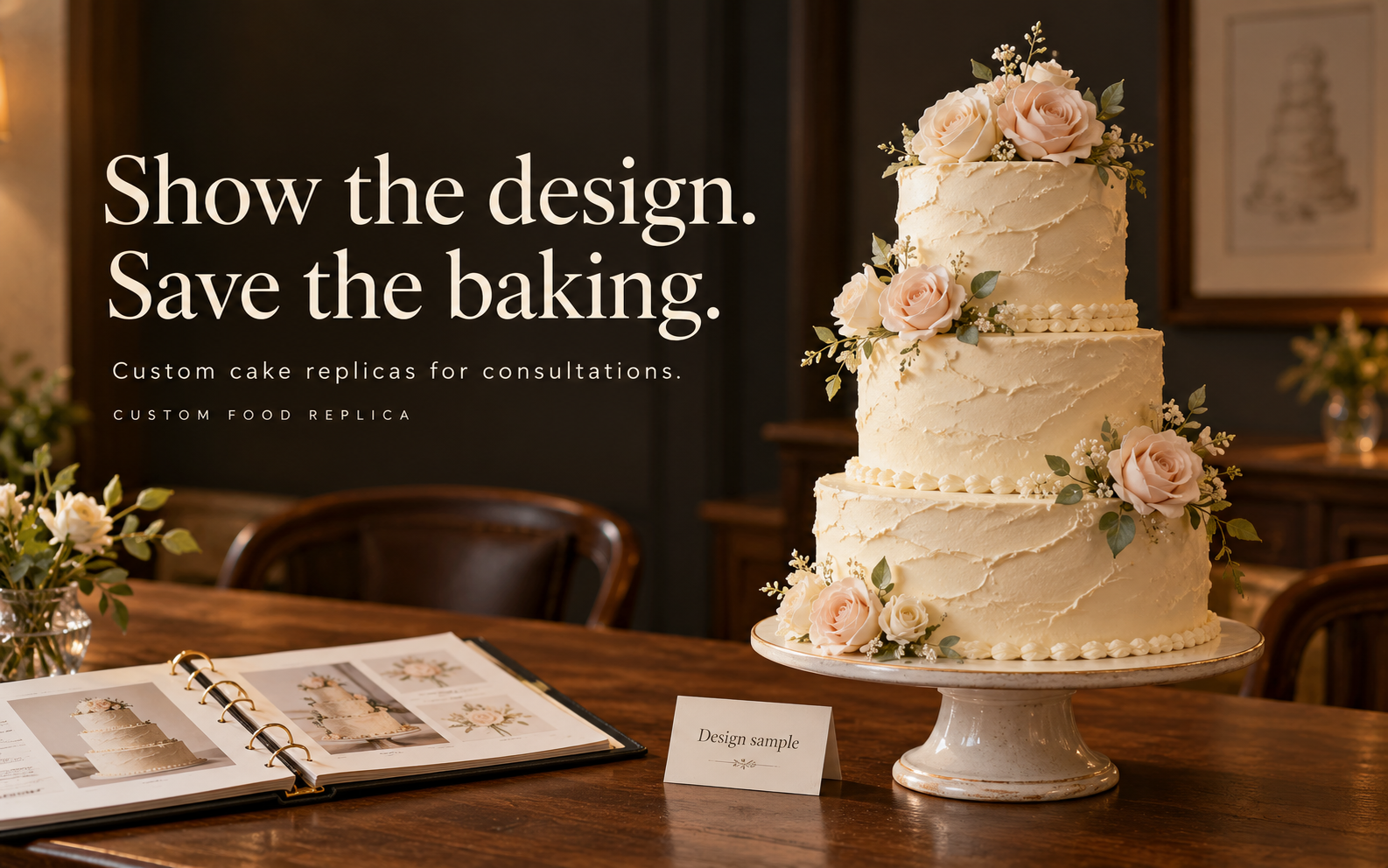
Most bakeries already use some form of fake display, most visibly in wedding and custom cake consultations, where a styrofoam dummy cake stands in for a design a couple hasn't ordered yet. These pieces exist so a customer can see a design, a flavor combination, or a “what a dozen looks like” reference without a baker producing real product that was never going to be eaten. A handcrafted replica is a direct upgrade: instead of a generic foam dummy that reads as obviously fake up close, a hand-painted replica of your actual cake design, icing work, and finish sells the idea far more convincingly, with zero ambiguity about whether it's for sale.
2. Visual fullness without overbaking
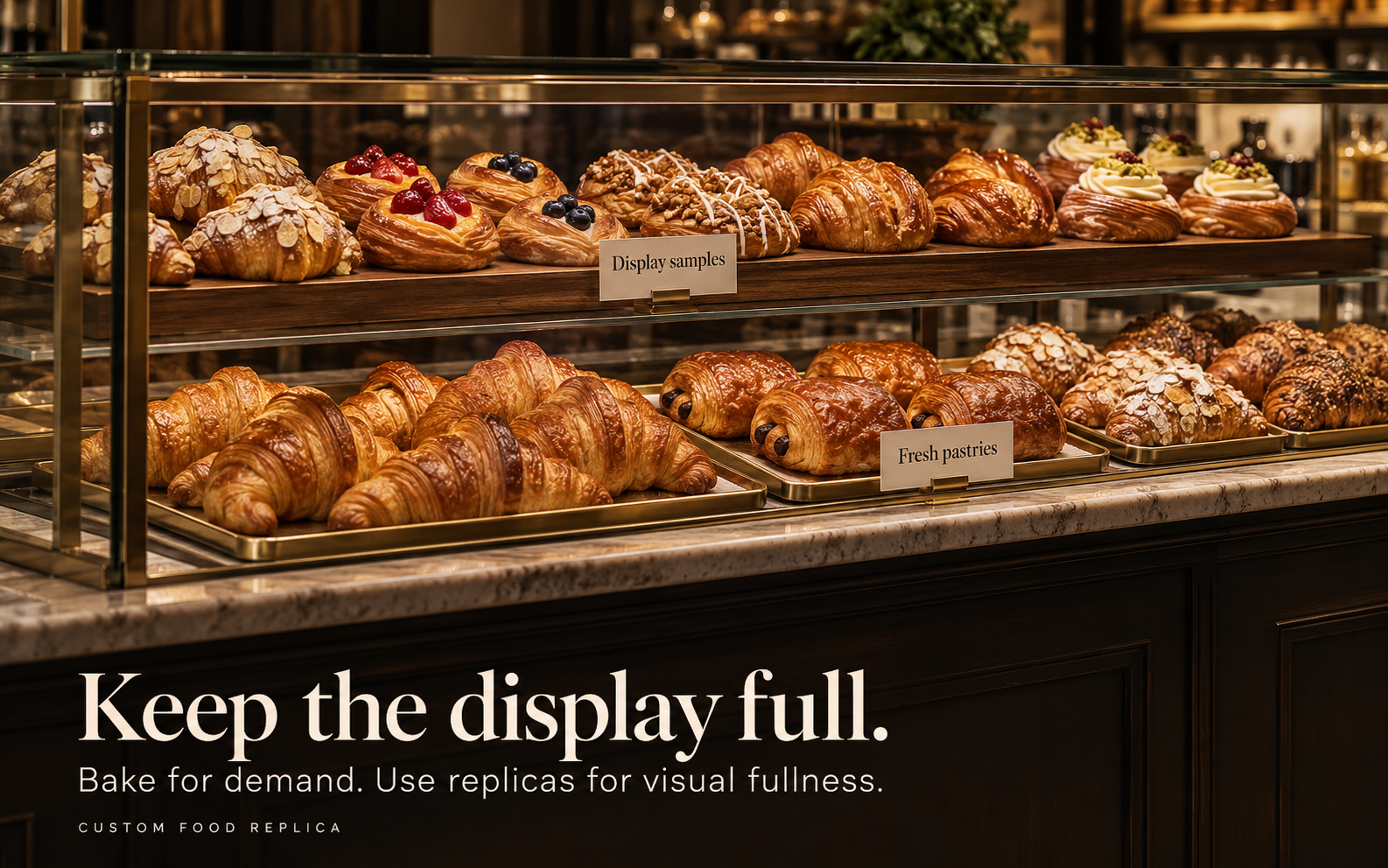
This is the direct fix for the half-empty case. Instead of baking extra real inventory so the case looks abundant late in the day, a bakery can use realistic replicas as back-row or top-tier filler, with real, sellable product kept in front and refreshed as it sells. The case still looks full all day, while the amount of real product baked can be sized to actual demand rather than padded for appearance. This is the piece of the data above a replica genuinely addresses: not spoilage from items sitting too long, but production and display padding that exists purely to avoid an empty-looking case.
3. Storefront and window display beyond the working case
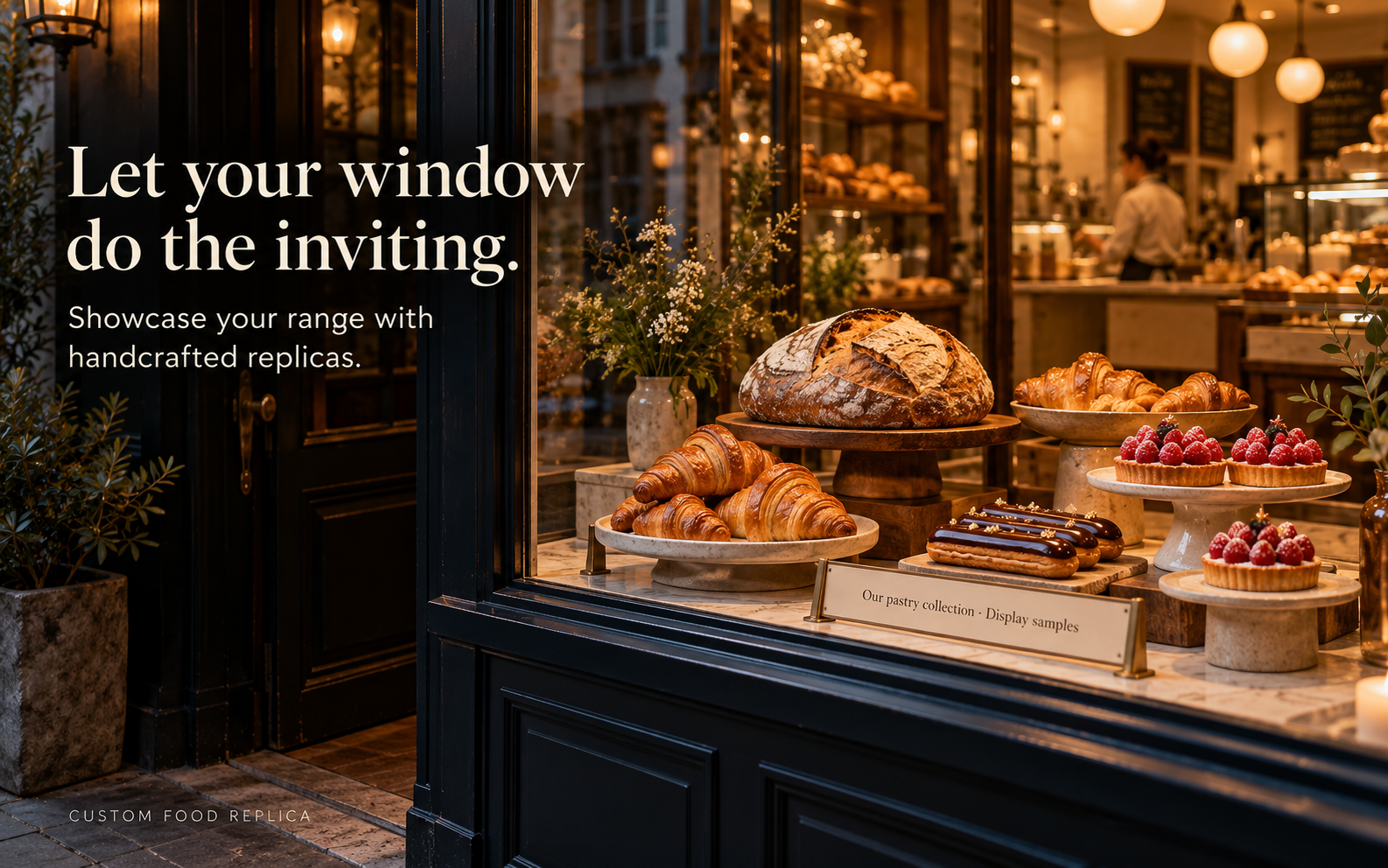
Your full range, including seasonal items, items that have sold out, or a pastry too delicate to sit all day without degrading, can be shown in a window or upper shelf the same way a restaurant window shows its full menu. This works exactly like the display logic in our restaurant window display ideas: it isn't inventory, it's a menu you can see from the sidewalk, pulling in foot traffic without every item needing to sit fresh that exact minute.
Why real pastries can't do these three jobs well
Real pastries are built to be eaten fresh and look their best for a short window. A croissant's lamination starts to soften within hours. Cream and custard fillings need refrigeration and have a short safe display life. Icing can weep, crust, or discolor sitting out all day. Fruit toppings brown. None of that matters for product that sells quickly, but it's exactly why using real product for consultation samples, case padding, or all-day window display creates waste: those pieces are held far longer, under harsher conditions, than any piece meant to be eaten.
A food replica looks right at 7am and right at closing, day after day. With proper indoor care, a replica typically lasts 3 to 5 years, and some pieces last 10 years or more when well maintained. See fake food vs real food for display for the full comparison.
Custom replicas versus generic fake bakery decor: know the difference
Search “fake bread” or “fake pastry decor” online and you'll mostly find generic kitchen and home staging props: foam loaves, resin donuts, and plastic cupcakes sold in bulk for photo backdrops or decoration. They're made in a handful of generic shapes, painted the same simple way every time, and sold cheaply because none of it represents any specific recipe.
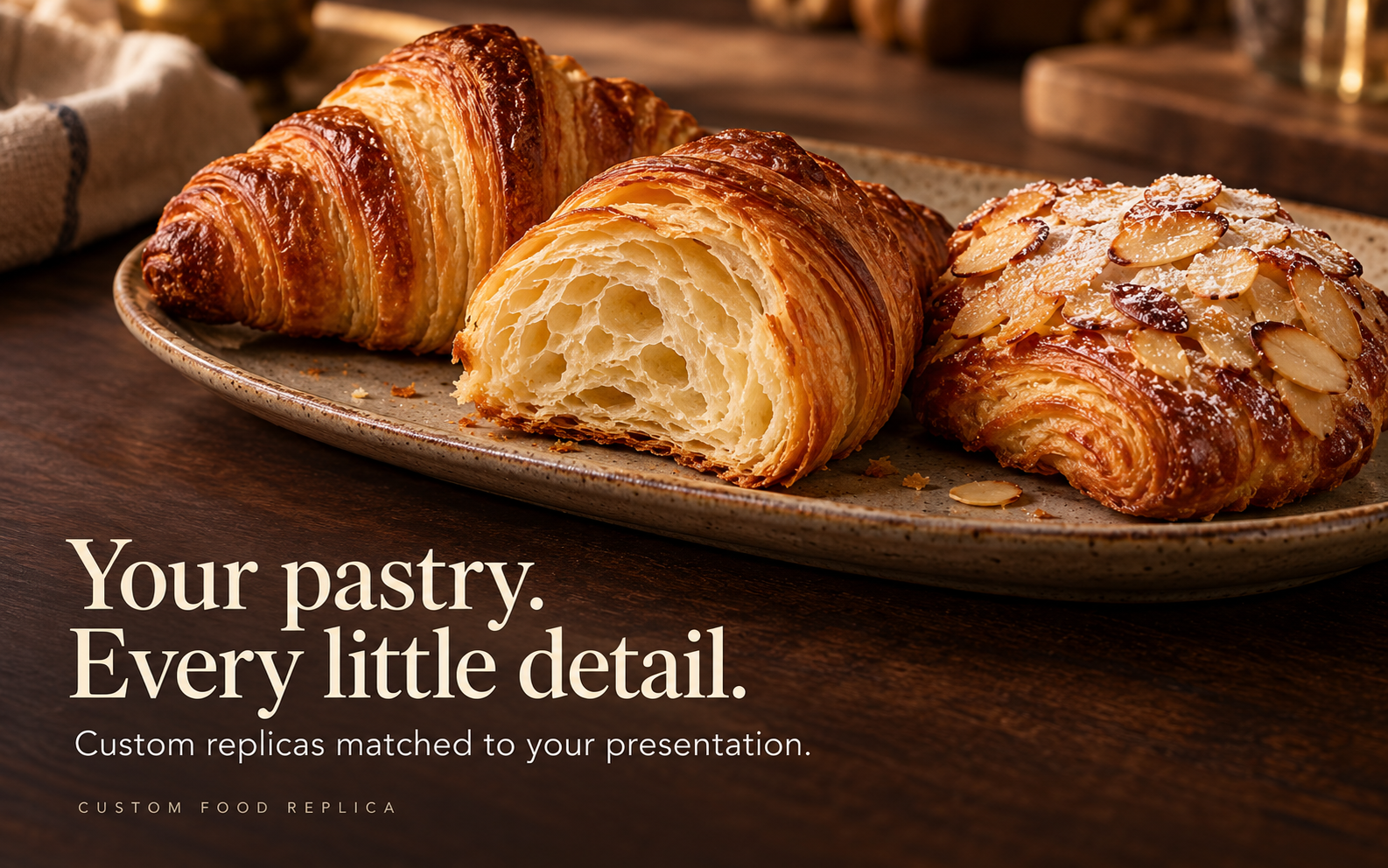
That's the wrong product for a working bakery. A consultation cake needs to match your actual icing style. A case filler needs to match your pastries closely enough that a customer can't tell which back-row pieces are real. A generic prop, with flat color and uniform shape, fails at both, and next to your real product the contrast gives it away immediately. A genuine custom replica is hand-sculpted and hand-painted from your recipe and presentation. Our custom vs stock guide explains where each belongs, and how food replicas are made walks through the craft behind shokuhin sampuru.
A note on what's easy to replicate, and what takes more planning
Not every bakery item is equally straightforward to match. Dry, shelf-stable items such as plain bread, bagels, cookies, and biscotti are generally easier to work from, including sending a physical sample to our Osaka location where that's useful. Iced, cream-filled, or fresh fruit topped pastries are a harder case to ship intact for the most precise match, the same challenge covered in our crepe and dessert wall post. For your most delicate items we lean more heavily on detailed, well-lit photos and specifications, and we'll tell you plainly at the quote stage what's feasible for your recipe.
What it costs, and the honest payback
A food replica is a one-time purchase. The savings it creates are specific to the waste it actually displaces, the padding, consultation, and window pieces above, not your total bakery waste, most of which is genuine overproduction and short shelf life that a display can't fix.
The honest way to check is to estimate what you currently spend each month on items baked purely for appearance or consultations, ingredients plus labor, and compare that ongoing cost to the one-time cost of replicas covering the same role. Bakeries that are genuinely padding a case or running frequent consultation samples often find the replica pays for itself within the first year, because the real-pastry cost never stops and the replica's cost does.
Custom replicas start at $400 per piece, all-in, including shipping and customs, with the per-piece price coming down as the order grows, so a full case filler set or a multi-tier showcase cake costs less per piece than a single item. See the full cost breakdown or get a quote.
The bottom line
Bakeries don't need to sell less or bake less for real demand. The waste worth targeting is narrower: the pieces made purely to be looked at, not eaten. A consultation cake, a case's back-row filler, and a storefront window are all jobs a handcrafted replica does for years, while your fresh product keeps selling exactly as it does now.
Cut the pastries baked for show
Send your showcase items and we'll quote replicas matched to your recipes.
Frequently asked questions
- Do bakeries really throw away pastries used only for display?
- A meaningful share of bakery production goes unsold, with industry data putting bread and bakery items among the highest waste categories in retail. Some of that comes specifically from overproducing or over-displaying to keep a case looking full, which is the part a replica addresses directly.
- Will customers be confused about what's real and what's a replica?
- No, when it's used correctly. Consultation and showcase pieces are understood as display samples, the same way a wedding cake dummy already works today, and case filler sits behind real, purchasable product that customers select and buy exactly as they do now.
- Can you match my specific cake design or pastry?
- Yes. Each piece is hand-sculpted and hand-painted from your actual recipe and presentation, using detailed photos and, where it's feasible for the item, a physical sample.
- Is every pastry equally easy to replicate?
- No. Dry, shelf-stable items like bread and cookies are generally easier to match closely, including with a physical sample, while iced, cream-filled, or fruit-topped pastries rely more on detailed photos and specifications.
- How is this different from the fake bread and pastries sold online?
- Generic fake bakery props are mass-produced in a handful of shapes for home decor or staging, not matched to any specific recipe. A custom replica is built to match your exact product, which is what lets it sit convincingly next to your real pastries.
- How much does a bakery display piece cost?
- Custom replicas start at $400 per piece all-in, including shipping and customs, with the per-piece price decreasing at higher quantities. A showcase cake or a case filler set is quoted to your specific items.
About the author
Custom Food Replica is the authorized US distributor and official partner of Iwasaki, the Japanese maker at the origin of the shokuhin sampuru food replica craft. We build hyperrealistic, made to order food replicas for US bakeries, restaurants, and retailers, each sculpted and hand-painted to match a client's exact recipe and shipped nationwide.
Sources
- ReFED, U.S. Food Waste Pact Data Report 2025: unsold food rates by retail department, including Breads and Bakery.
- Pacific Coast Food Waste Commitment, as reported by The Daily Meal: bakery items as a share of unsold retail food in the US.
- Retail food waste research: overstocking for aesthetic abundance displays as a documented driver of waste in fresh departments.